Clinical Evidence and Validation
This page states the evidence position plainly, because that is what a sponsor needs before choosing an endpoint. Three things are true at once, and they should not be conflated:
- The CLASI instrument itself is validated in cutaneous lupus erythematosus.
- The device that measures its visual signs is a CE-marked medical device, whose sign measurements are verified and validated as part of its technical documentation and clinical evaluation, and cutaneous lupus erythematosus falls within its registered intended use. The device is validated, and that validation covers measuring these signs on CLE skin.
- What has not been carried out is a study characterising how closely the assembled CLASI-A and CLASI-D reproduce expert CLASI scoring in a CLE cohort specifically. That is an additional evidence step a sponsor may want for a particular endpoint, not a precondition for use.
Everything below separates what is established from what such a CLE-specific study would add.
The CLASI instrument is validated
CLASI is not an experimental scale. It was developed and validated by Albrecht and colleagues, with content validity assessed by a panel of dermato-rheumatologists and inter- and intra-rater reliability estimated on real patients, and it has since become the reference outcome measure in cutaneous lupus trials.
- Development and reliability: Albrecht J, et al. The CLASI: an outcome instrument for cutaneous lupus erythematosus. J Invest Dermatol. 2005;125(5):889-894.
- Responsiveness and severity strata: Klein R, et al. Development of the CLASI as a tool to measure disease severity and responsiveness to therapy in cutaneous lupus erythematosus. Arch Dermatol. 2011;147(2):203-208. This work established the activity strata (mild 0–9, moderate 10–20, severe 21–70) and found that a clinically meaningful response corresponds to roughly a 4-point or 20% fall in the activity score.
- Reliability across raters and specialties: subsequent studies have evaluated CLASI reliability in adult and paediatric cohorts and across dermatology and rheumatology.
The consequence for this programme is precise: the scoring system is sound, so the open question is confined to automating its visual components in CLE, not to whether CLASI measures the disease. Full citations are on the Publications page.
The component measurements are validated in their source indications
The device does not have a single "CLASI model". It measures the individual visual signs CLASI is built from, using models developed and validated in other dermatological indications, and assembles them. Each measurement therefore carries real validation evidence, earned outside CLE:
| CLASI sign | Device measurement | Validated in | Evidence |
|---|---|---|---|
| Erythema | Erythema intensity and extent | Inflammatory dermatoses (psoriasis, acne) | Acne, Psoriasis |
| Scale, induration | Desquamation and induration intensity | Psoriasis | Psoriasis |
| Dyspigmentation | Depigmentation extent | Vitiligo | Vitiligo segmentation |
| Alopecia | Hair loss percentage | Alopecia areata | Alopecia |
| Image quality | DIQA | All indications | DIQA validation |
The measurement machinery is therefore validated and CE-marked, and cutaneous lupus is within its registered intended use, so measuring these signs on CLE skin is covered by the device's validation. What an additional CLE-specific study would add is a direct characterisation of how faithfully the assembled CLASI reproduces expert CLASI scoring in CLE, where lesion morphology and skin tone differ from the source indications.
Feasibility findings on CLE imagery
To test whether the pipeline behaves sensibly on cutaneous lupus, the device was run on generated CLE images spanning discoid and subacute presentations across skin phototypes. These are synthetic images with no CLASI ground truth, so the findings describe how the models behave, not how accurately they score CLASI. Full detail is in the internal feasibility report.
Image quality. All test images cleared the DIQA quality gate and the dermatological-domain check, at quality scores of 72 to 91 ("Good" to "Excellent"). The capture pipeline is viable for CLE imagery.
Erythema source. Of the several scoring systems that expose an erythema measurement, only one family tracked the removal of active erythema between a baseline and a treated follow-up; the psoriasis and eczema erythema models read the residual colour of a healed plaque as unchanged erythema. Since CLASI grades active erythema, this identifies which measurement source to use for CLE erythema and which to avoid, a choice to confirm against expert scoring.
Repigmentation. On a matched baseline and follow-up of the same lesion, the continuous depigmentation measure roughly halved while the binary CLASI-D dyspigmentation item did not move, demonstrating the resolution the continuous measure adds over the instrument.
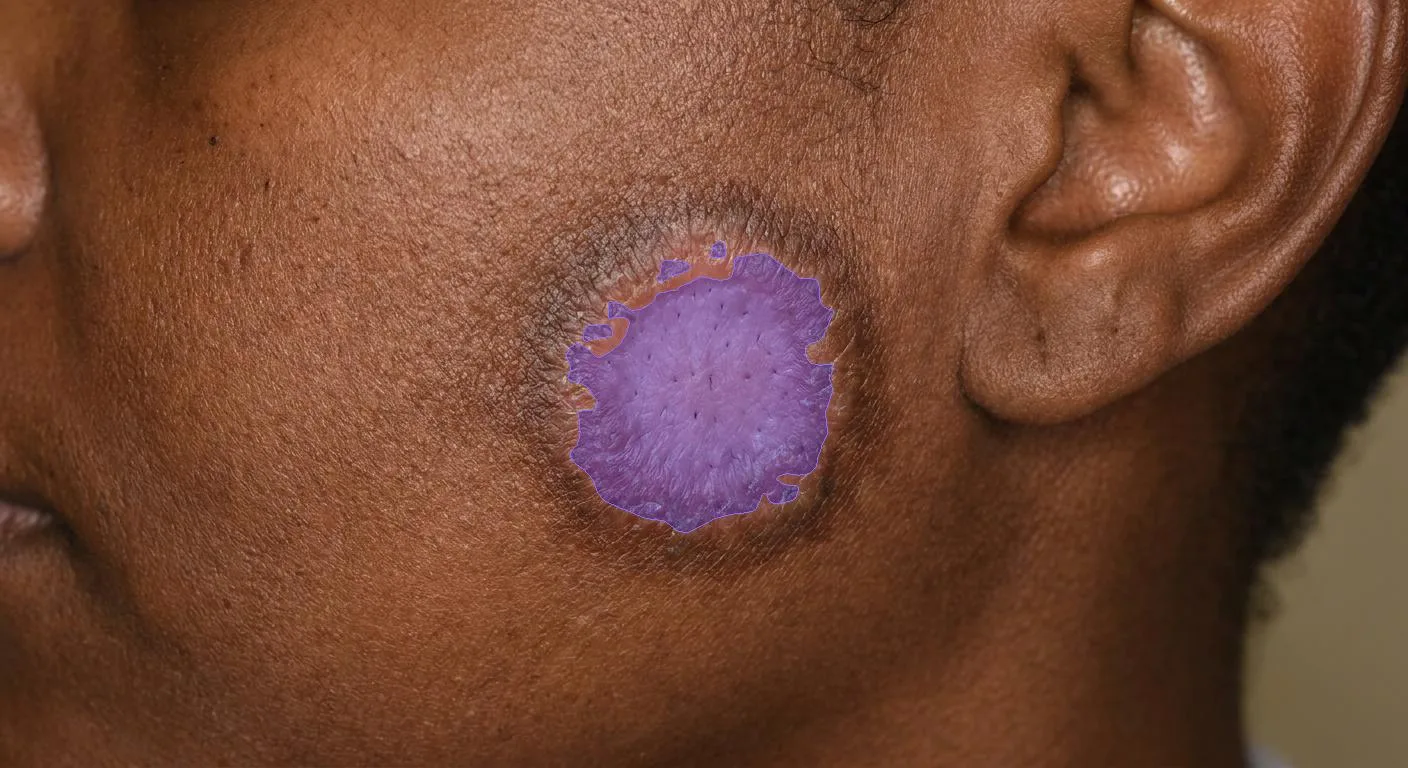
Baseline: depigmentation mask over the full pale centre
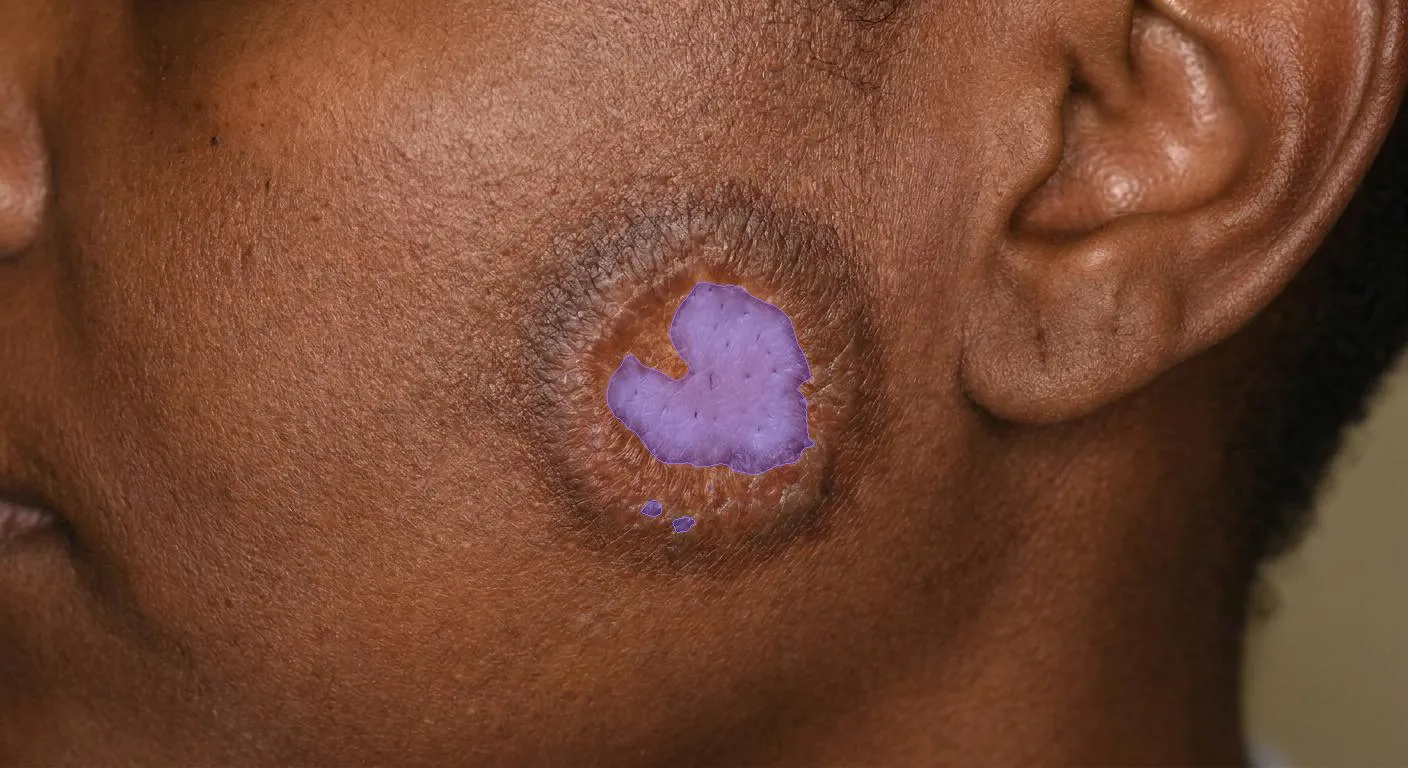
Follow-up: the mask follows the repigmenting border inward
Skin phototype. Erythema and depigmentation behave in opposite directions across phototypes: erythema is a high-contrast target on light skin and harder on dark, depigmentation the reverse. This is a property of contrast, not of any one model, and it shapes which measurement is reliable in which population. See Limitations.
Reproducibility
Independently of accuracy, the device returns the identical value for the identical image, at every site, with no calibration drift and no inter- or intra-rater variability. Manual CLASI, by contrast, carries the rater variability the original reliability studies quantified. Perfect reproducibility is the property that keeps a multi-year CLASI-D damage trajectory comparable with its own baseline, even across changes of site personnel, and it reduces the measurement noise that determines the sample size a given treatment effect requires.
The validation pathway
The study that would establish accuracy is well defined and inexpensive as a first step.
Retrospective validation against expert CLASI. Any sponsor that has run a CLE trial holds a longitudinal image set whose visits already carry clinician-scored CLASI-A and CLASI-D. That pairing, images against expert scores, is exactly what a validation needs, so the first study requires no new patients, sites or capture. Its feasibility depends only on how well the images are labelled by patient, visit and region, which is a scoping exercise measured in days.
What it would report. Agreement between the automated components and expert scoring (intraclass correlation and limits of agreement), benchmarked against the manual inter-rater reliability the instrument's own literature documents, and the responsiveness of the automated CLASI-A against the established 4-point or 20% threshold.
Positioning. The device produces the CLASI components today, within a validated, CE-marked device. A sponsor seeking an AI-derived CLASI as a primary registration endpoint would run the agreement study first; in the meantime it serves as a supportive or exploratory measure alongside clinician CLASI, which is also the configuration that generates the paired data such a study needs. The two study shapes, retrospective and prospective, are set out on the Trial workflow page.