Certified as a medical device, for the whole of the skin.
On 15 September 2026, BSI certified Legit.Health under the EU Medical Device Regulation as a Class IIb medical device. It is also registered as a medical device in Brazil, with ANVISA, and in the United Kingdom, with the MHRA. Legit.Health is the first and only company with an MDR-certified medical device that supports the diagnosis of multiple skin conditions, not only skin cancer, and also measures how severe they are. And because Legit.Health carries the certification, in our reading of the EU guidance a system that uses it as intended does not need one of its own.
 European Union: certified by BSI under the MDR, Class IIb
 Brazil: registered with ANVISA, Class II
 United Kingdom: registered with the MHRA
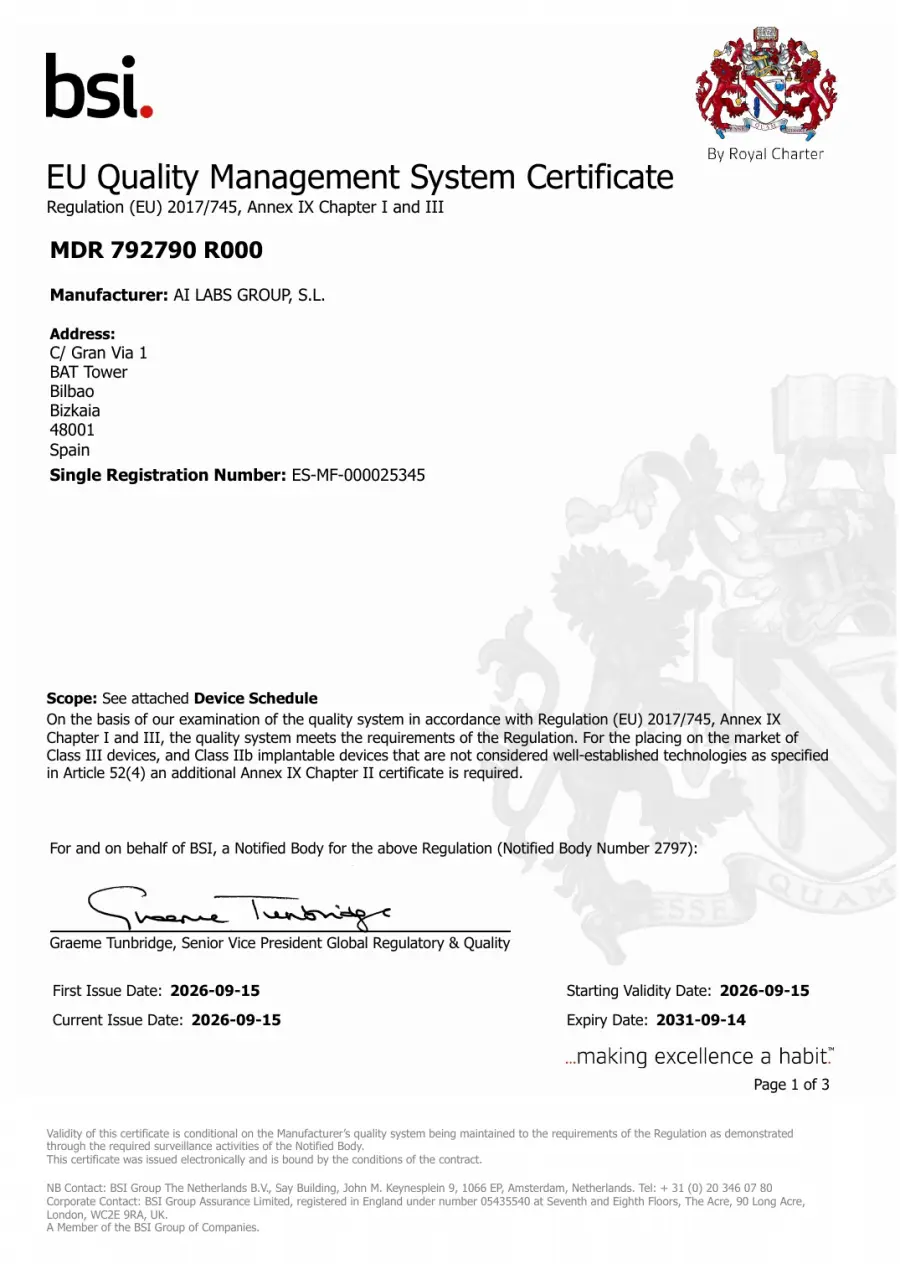
The certificate
What BSI certified, and until when.
A notified body is the independent organisation the European Union designates to check that a medical device meets the Medical Device Regulation before it can carry the CE mark. Ours is BSI, one of the largest. These are the facts on the certificate itself, so a procurement team can check them against the document.
In short: a Class IIb medical device, certified by BSI Group The Netherlands B.V. as Notified Body 2797, and valid until 14 September 2031, subject to BSI's ongoing surveillance of our quality system.
Outside the European Union, Legit.Health is registered with ANVISA in Brazil as a Class II medical device (notification 81987060015, published on 2 June 2025), and registered with the MHRA for the United Kingdom market.
| Field | On the certificate |
|---|---|
| Certificate | EU Quality Management System Certificate MDR 792790 R000 |
| Regulation | Regulation (EU) 2017/745 on medical devices (MDR) |
| Conformity assessment | Annex IX, Chapters I and III |
| Notified body | BSI Group The Netherlands B.V., Notified Body number 2797 |
| Device class | Class IIb, medical device software for general medicine diagnosis and monitoring |
| Manufacturer | AI Labs Group, S.L., the company behind Legit.Health, Bilbao, Spain |
| Single Registration Number | ES-MF-000025345 |
| First issued | 15 September 2026 |
| Expires | 14 September 2031 |
What is certified
Every visible skin condition, and how severe it is.
A certificate covers an intended purpose: what a device is for, in whom, and by whom. Ours is written on the certificate's device schedule, and it is broad on purpose. It does not name a single disease, because Legit.Health is for the whole of the skin.
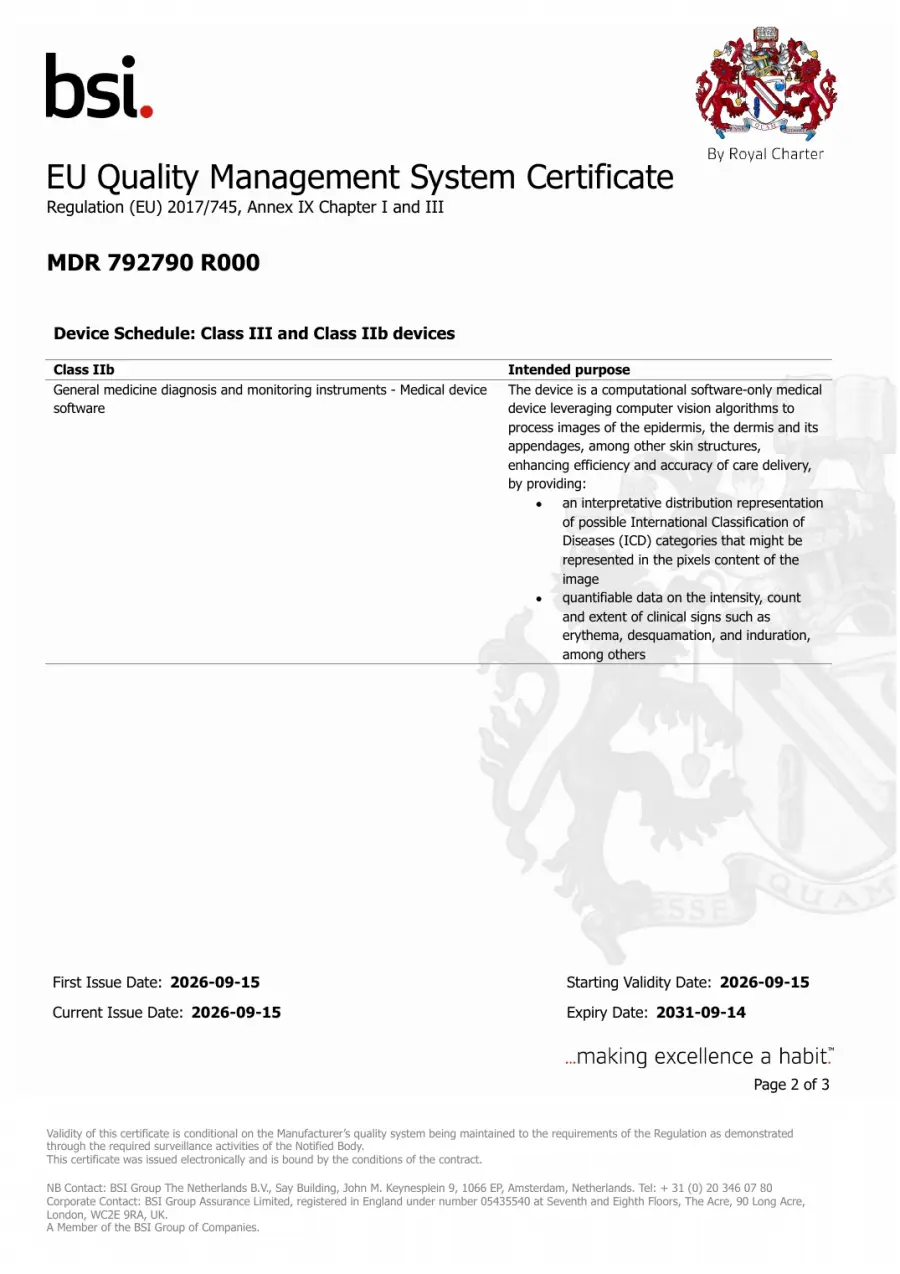
This is the certified intended purpose, word for word as it appears on page 2 of the certificate:
The device is a computational software-only medical device leveraging computer vision algorithms to process images of the epidermis, the dermis and its appendages, among other skin structures, enhancing efficiency and accuracy of care delivery, by providing:
- an interpretative distribution representation of possible International Classification of Diseases (ICD) categories that might be represented in the pixels content of the image
- quantifiable data on the intensity, count and extent of clinical signs such as erythema, desquamation, and induration, among others
What that means in practice
- Diagnosis support for every visible condition: the first bullet is the ranked differential Legit.Health returns for each photograph, coded to ICD. It covers all diseases of the skin, its appendages such as hair and nails, and the associated mucous membranes, from the common to the rare.
- Severity measurement: the second bullet is what turns a photograph into a score. Legit.Health measures the intensity, count and extent of clinical signs, which are what validated scores such as PASI, SCORAD or IHS4 are calculated from, so a patient's response to treatment can be followed.
- For every patient: the intended patient population is adults and children with skin findings, across Fitzpatrick skin types I to VI, in primary care, general dermatology and specialist referral.
- Photographed by clinicians or patients, read by healthcare professionals: the instructions for use name both healthcare providers and patients as the people who take the photographs. The result is one element of the clinical assessment, read by a healthcare professional. It supports a decision; it does not confirm a diagnosis on its own.
How it compares
Most certified dermatology AI covers skin cancer only.
The certified AI devices in dermatology are, for the most part, certified for skin cancer: they look at a lesion and estimate whether it is malignant. That is an important question, and Legit.Health answers it too. It is also only one of the questions a dermatology service has to answer. The table compares our intended purpose with that of DERM by Skin Analytics, a well-known skin cancer device, as each manufacturer states it in its own instructions for use.
| Question | Legit.Health | DERM, by Skin Analytics |
|---|---|---|
| Which conditions? | All diseases of the skin, its appendages and associated mucous membranes | Lesions suspicious for skin cancer; not for other concerns such as rashes, eczema, infectious diseases or lupus |
| Does it measure severity? | Yes: intensity, count and extent of clinical signs | No |
| Can it follow treatment? | Yes: severity is measured at each visit, so the response to treatment can be followed over time | No: monitoring treatment and staging of disease are listed as limitations of use |
| Which ages? | Adults and children | 18 years or over |
| Which skin types? | Fitzpatrick I to VI | Primarily evaluated on Fitzpatrick I to IV; to be used with caution on other skin types |
| Who reads the result? | Healthcare professionals | Healthcare professionals; patients may capture images but are not intended to use the outputs |
| What role in the decision? | Supports the clinician's assessment; never confirms a diagnosis on its own | Can be used as an automated clinical management tool, issuing management instructions without review by a clinician |
The Fitzpatrick scale sorts skin into six phototypes, from the palest (I) to the darkest (VI). Legit.Health is intended for all six. DERM's instructions for use say it was evaluated mostly on types I to IV and is to be used with caution on the others, which in practice means patients with darker skin.
Our intended patient population is adult and paediatric patients, so children of any age as well as adults. DERM lists patients under 18 among its limitations of use: it is not to be used on children or adolescents.
We took DERM's column from Skin Analytics' own instructions for use for DERM v5.0 (document SA-001165-LB, Issue 16), as published on 2 October 2026, and ours from our instructions for use. Both columns state what each manufacturer says its device is for and must not be used for; neither describes how well either device performs.
Why the scope matters
- One device for the whole pathway: triage, diagnosis support and follow-up with the same device, instead of a skin cancer tool beside other tools for everything else.
- Children and darker skin, in scope: both are within the intended purpose, so a service that sees children, or patients with darker skin, does not need a separate route for them.
- A measure, not just a label: severity scores are what decide treatment and show whether it worked, and they are inside the certified purpose.
Your system
Legit.Health is certified, so your system does not have to be.
The certificate does a second job, and for anyone integrating Legit.Health it is the one that matters most. When the medical work is done by a certified medical device, the software around it, your patient record, your app or your triage board, does not become a medical device for including it. It is the same reason our own app is not a separate medical device: it is how you reach the certified device, not a new one.
The question the regulation asks
European guidance on software, MDCG 2019-11, starts from intended purpose. In the words of its current revision:
Software must have a medical purpose on its own to be qualified as a MDSW (MDSW). It should be noted that the intended purpose, as described by the manufacturer of the software is relevant for the qualification and classification of any device.
The medical purpose here belongs to Legit.Health: it searches each photograph for findings and measures them, which the guidance gives as its own example of medical device software. Your system's purpose is to run the service around that result.
- Is it software? Yes. Your system is software, so the guidance applies to it.
- Is it an accessory, or does it drive a hardware medical device? No. It embeds our app and receives the report, which is communication between two systems.
- Does it do more than store, archive, communicate or search? Usually yes: it files the report, books the appointment, assigns the case to a team. That alone does not make it a medical device; the next question decides.
- Does it create medical information for individual patients? No. The medical information is created by Legit.Health. Your system applies your own pathways to it, and the guidance lists generic pathways, staff planning and data parsing among the things that are not medical device software.
The module carries the certification
MDCG 2019-11 describes exactly this arrangement, an information system with a medical module inside it:
Information Systems that are intended only to transfer, store, convert, format, archive data are not qualified as medical devices in themselves. However, they may be used with additional modules which maybe qualified in their own right as medical devices (MDSW).
Legit.Health is that module, qualified in its own right and now certified. It carries the CE mark, the clinical evidence and the post-market surveillance, so your system does not have to.
Three conditions keep it that way
- The same intended purpose: your system makes no clinical claims of its own, and says that the medical function is performed by Legit.Health.
- Legit.Health's output, unaltered: you display and route the report as Legit.Health returns it, without recomputing it or adding clinical reasoning of your own.
- The same users: the result reaches healthcare professionals, with the information the instructions for use require beside it, which the app shows for you.
Good to know
- Rules that order the work. Thresholds you set over Legit.Health's indexes, to order a worklist or propose a pathway, are generic pathways in the guidance's own terms, not medical information about an individual patient; the decision for each patient stays with a healthcare professional.
- Risk is not the test. The guidance is explicit that the risk of harm "is not a criterion on whether the software qualifies as a medical device". Risk decides the class of a medical device under Rule 11 of the MDR, which is how ours became Class IIb; it does not decide whether your system is one.
- What would change it. Under Article 16 of the MDR, whoever changes the intended purpose of a certified device, or modifies it in a way that can affect its compliance, takes on the manufacturer's obligations. Integrating Legit.Health as it is does neither.
- Always separable. Because Legit.Health is a separate module, it can be switched off without touching the rest of your system, should a regulator ever see a particular use differently.
- Where this applies. This reasoning is for the European Union, where Legit.Health is certified. In other markets the answer depends on the local rules and on Legit.Health's status there.
- Your call, with your adviser. This is our reading of the European guidance, offered to help you. Whether a particular system is a medical device is for its manufacturer to decide, with its own regulatory adviser.
Source: MDCG 2019-11 Rev.1, Guidance on Qualification and Classification of Software in Regulation (EU) 2017/745 and Regulation (EU) 2017/746, June 2025.
Questions
About the certification
The answers procurement teams, clinicians and regulators ask for most often, in one place.
Is Legit.Health certified under the EU MDR?
Yes. BSI, Notified Body 2797, issued certificate MDR 792790 R000 under Regulation (EU) 2017/745 on 15 September 2026. It covers Legit.Health as a Class IIb medical device and is valid until 14 September 2031.
Is it only for skin cancer?
No. The certified intended purpose covers every visible skin condition: a ranked differential of possible ICD categories, and measurement of the intensity, count and extent of clinical signs. Skin cancer and malignancy suspicion are part of it, not the limit of it.
Can it be used with children and with every skin type?
Yes. The intended patient population is adult and paediatric patients across Fitzpatrick skin types I to VI.
Does it replace the clinician?
No. The result is one element of the clinical assessment, read by a healthcare professional. Legit.Health supports the decision; it never confirms a diagnosis on its own.
If we integrate Legit.Health into our system, does our system become a medical device?
In our reading of the European guidance, no, provided your system keeps to Legit.Health's intended purpose and shows its output unaltered to healthcare professionals. The final call is yours, with your regulatory adviser. The medical function is performed by Legit.Health, a certified device, and MDCG 2019-11 treats the system around a certified module as an information system, not a medical device. The section Your system explains why.
Is the app a medical device of its own?
No. The app is how a clinician or a patient reaches the certified device, embedded in your platform: it has the same intended purpose and the same users, and it presents Legit.Health's output without adding clinical reasoning of its own.
What about the earlier version of Legit.Health?
The earlier version of Legit.Health was CE-marked under the previous Medical Device Directive (MDD). This certificate is for the new device under the MDR, which is broader in scope and was assessed against the stricter regulation.
How can I see what Legit.Health returns?
The features page shows each output, and the implementation method page explains how it is implemented: as one app embedded in your own system, with its API.
Let's schedulea live demo
Legit.Health is the all-in-one artificial intelligence solution with ultra high performance, exclusive features and clinical backing.