Acne Severity Endpoints for Clinical Trials
The AI scoring provided by Legit.Health delivers automated, clinically validated acne severity scoring for clinical trials, quantifying inflammatory lesion count, spatial density, and IGA-aligned severity: the endpoints recommended by FDA guidance for establishing acne treatment effectiveness.
IGA
3
ModerateAcne Lesion And Density Index
3.5
ModerateScale 0 – 4 (continuous)
Timestamp
2025-01-15 10:30 UTC (example)
Analysis performed in
1.2 seconds
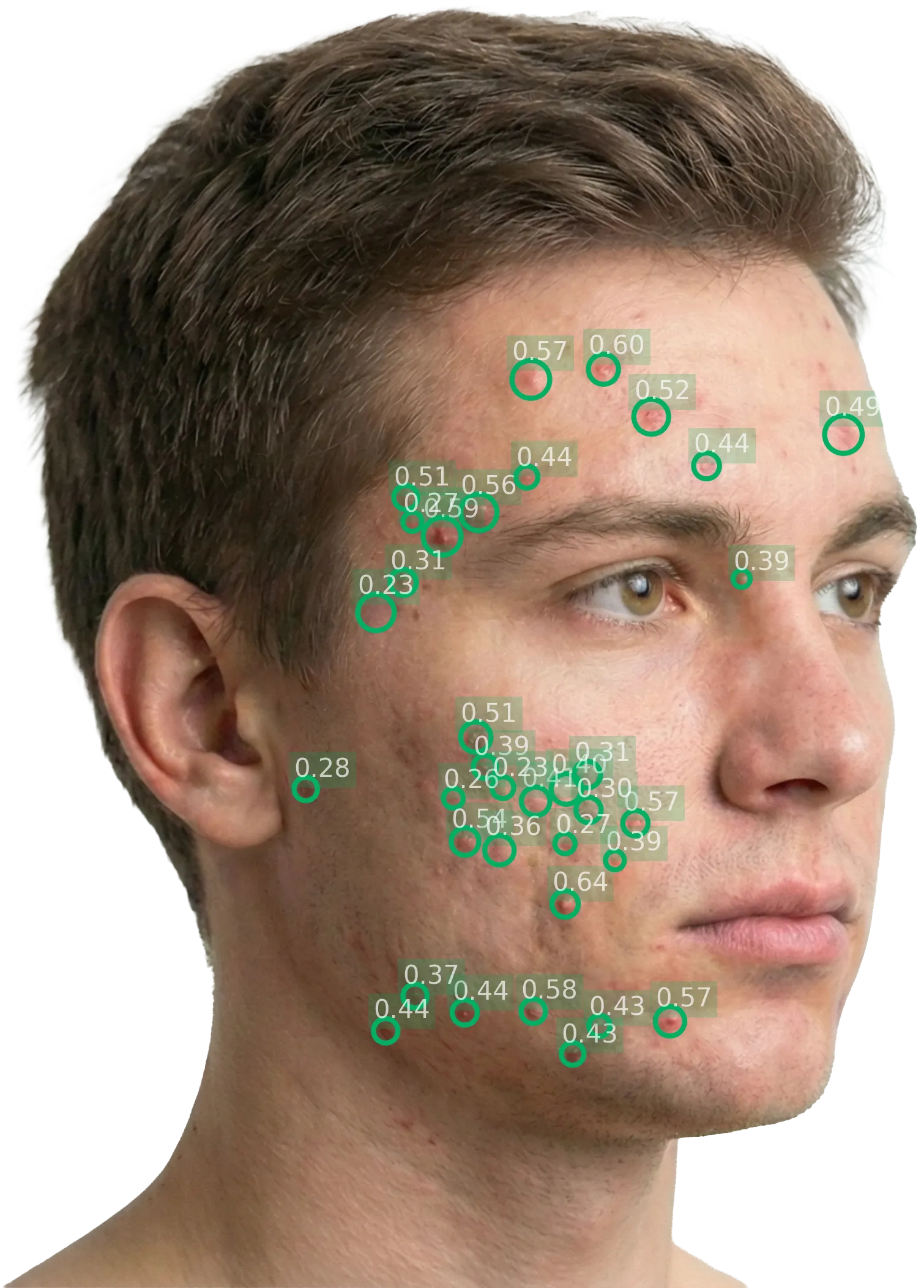
Body site
Left diagonal
Image quality
92%
Lesion count
36
Density
0.55
Local score
3.42
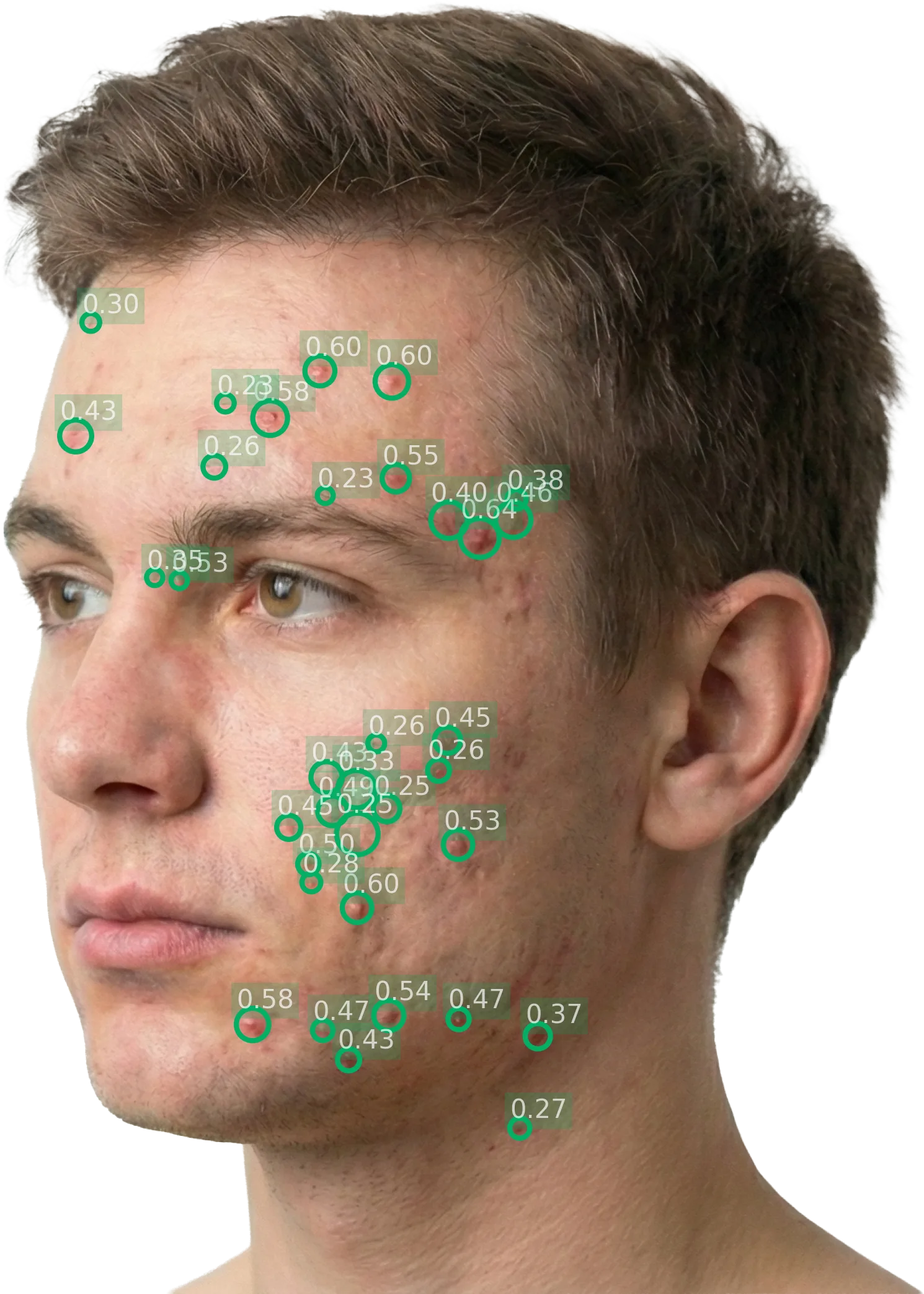
Body site
Right diagonal
Image quality
88%
Lesion count
35
Density
0.6
Local score
3.49
FDA guidance context
The FDA’s guidance document Acne Vulgaris: Establishing Effectiveness of Drugs Intended for Treatment. Guidance for Industry. (2005) establishes the standard for clinical trial endpoints:
- Assessment of treatment effect should be based on both changes in lesion counts and success on the IGA, as these provide both quantitative and qualitative assessments of acne and useful complementary information.
- Inflammatory and non-inflammatory lesions should be counted and reported separately.
- The IGA should use a validated 5-point scale (0–4: Clear to Severe).
- Efficacy assessment should be limited to the face, as it is the most frequent site of involvement.
Endpoint capabilities
The AI provides four distinct endpoints, each configurable per study protocol:
- AI output
- Integer count per perspective and total
- Typical use in protocol
- Co-primary
- AI output
- Density score 0–1 per perspective
- Typical use in protocol
- Exploratory
- AI output
- 0–4 scale (Clear to Severe)
- Typical use in protocol
- Co-primary
- AI output
- 0–10 continuous scale
- Typical use in protocol
- Exploratory
The inflammatory lesion count and IGA are the two co-primary endpoints recommended by FDA guidance. Spatial density adds a dimension that lesion count alone misses; two patients with 30 lesions can have very different clinical presentations depending on whether those lesions are scattered or clustered in a concentrated area. The ALADIN composite (Acne Lesion And Density INdex) combines count and density into a single higher-resolution continuous scale.
How the AI works
The scoring pipeline processes each uploaded photograph in three stages:
Stage 1: Inflammatory lesion detection
A deep learning object detection model identifies individual inflammatory acne lesions and draws bounding boxes around each one. The model detects papules, pustules, and nodules; comedones (non-inflammatory lesions) are excluded, consistent with IGA methodology and the FDA recommendation to count inflammatory and non-inflammatory lesions separately.
Stage 2: Spatial density computation
The density score captures not just how many lesions are present, but how closely they cluster together:
where is the area of overlap between circular regions centered on detected lesions and is the total area covered by all detection regions. This distinction is clinically relevant: scattered mild acne and concentrated moderate acne can have identical lesion counts but very different severity perceptions.
Stage 3: IGA-aligned severity scoring
The lesion count and density are combined into a severity score aligned with the 5-point IGA scale:
where is the lesion count, is the spatial density, and , are empirically derived constants calibrated against the consensus of three board-certified dermatologists. The ALADIN composite score is then computed as IGA × 2.5, mapping to a 0–10 continuous scale.
| IGA score | Severity | Clinical description |
|---|---|---|
| 0 | Clear | No inflammatory lesions |
| 1 | Almost clear | Rare inflammatory lesions with very low density |
| 2 | Mild | Some inflammatory lesions, low to moderate density, no nodules |
| 3 | Moderate | Many inflammatory lesions, moderate to high density, occasional nodules |
| 4 | Severe | Numerous inflammatory lesions, high density, many nodules |
Visual report
The AI produces a structured severity report for each assessment:
IGA
3
ModerateAcne Lesion And Density Index
3.5
ModerateScale 0 – 4 (continuous)
Timestamp
2025-01-15 10:30 UTC (example)
Analysis performed in
1.2 seconds
Body site
Left diagonal
Image quality
92%
Lesion count
36
Density
0.55
Local score
3.42
Body site
Right diagonal
Image quality
88%
Lesion count
35
Density
0.6
Local score
3.49
Protocol flexibility
The imaging and scoring protocol adapts to your study's needs. Legit.Health works with sponsors and CROs to configure the optimal protocol during study setup.
Imaging perspectives
| Protocol | Perspectives | Use case |
|---|---|---|
| Standard (Hayashi Criterion) | 2 views: Left diagonal (~70°), Right diagonal (~70°) | Most acne studies; captures majority of facial acne area per the Hayashi Criterion for counting inflammatory lesions per half-face. |
| Three-perspective | 3 views: Left perpendicular, Frontal, Right perpendicular | Studies requiring full-face frontal coverage. The frontal view overlaps with both lateral views; facial landmark detection deduplicates lesions. |
| Custom | Any combination of perspectives | Any combination of perspectives, defined in collaboration with the sponsor during protocol design. |
Global score aggregation
The system computes a local score (lesion count, density, IGA) for each perspective. The global score is derived from local scores using a configurable aggregation method:
| Method | Formula | When to use |
|---|---|---|
| Maximum (default) | Captures the worst-affected area. Recommended for most acne protocols. When dermatologists perform a global IGA assessment, they are primarily influenced by the most severely affected region. | |
| Sum | Captures cumulative severity across the face. Useful when total burden matters. | |
| Mean | Average severity. Useful when perspectives have significant overlap. |
Overlap handling
When perspectives overlap, the AI uses Facial landmark detection to prevent double-counting:
- Landmark identification: The AI detects facial landmarks (eyes, nose, mouth, jawline, forehead boundaries) in each image.
- Region mapping: Each perspective is mapped to the facial regions it covers, based on the detected landmarks and the known capture angle.
- Overlap detection: Lesions that appear in overlapping regions between two perspectives are identified using their spatial position relative to the facial landmarks.
- Deduplication: Overlapping lesions are counted only once, attributed to the perspective with the highest confidence detection.
This enables flexible multi-perspective protocols without sacrificing accuracy.
Further reading
Scoring Methodology
Technical deep dive into the acne scoring pipeline, covering inflammatory lesion detection, spatial density computation, IGA calculation, ALADIN composite, multi-perspective scoring, overlap handling, and reproducibility.
Imaging Protocol
Image capture protocols for acne clinical trials, covering smartphone-based photography, DIQA quality control, multi-perspective flexibility, facial landmark detection, and site standardisation.
Clinical Evidence
Performance validation of acne severity endpoints, covering how the ground truth is established, what the metrics mean, ALADIN vs. dermatologist agreement, lesion detection performance, and the regulatory evidence pathway.
Trial Workflow
End-to-end clinical trial workflow for acne severity endpoints, covering protocol design, patient enrollment, image capture, AI scoring, severity tracking, data export, EDC integration, and decentralised trial support.
Sample Outputs
Concrete examples of what sponsors, CROs, and investigators receive from acne severity assessments: per-visit AI reports with lesion detection overlays, longitudinal severity tracking, and structured EDC data exports.
Publications
Peer-reviewed publications, conference presentations, key references from the dermatology literature, and the complete clinical validation portfolio supporting acne severity endpoints.
Limitations
Transparent documentation of what the AI acne severity scoring can and cannot do, including scope boundaries, validation gaps, and how each limitation is managed.