Sample Outputs and Deliverables
This page shows the concrete outputs that sponsors, CROs, and investigators receive from each hidradenitis suppurativa severity assessment. The AI generates standardised AIHS4 reports immediately after image submission.
Per-visit AIHS4 report
Each image submission generates a complete AIHS4 report, accessible within seconds:
What the report contains
| Output | Detail |
|---|---|
| Global AIHS4 score | Weighted composite (nodules×1 + abscesses×2 + fistulae×4) |
| Severity classification | Mild (0–3) / Moderate (4–10) / Severe (≥ 11) |
| Per-region lesion counts | Papules/nodules, abscesses, fistulae per anatomical area |
| Per-region IHS4 contribution | Weighted score per region |
| Hurley stage estimate | I / II / III based on lesion distribution |
| Annotated images | Colour-coded bounding boxes by lesion type |
| Image quality (DIQA) | Quality score per image; failed images flagged for recapture |
| Timestamp | UTC timestamp of capture and AI processing |
AI visual outputs
Lesion detection with type classification
Each HS lesion is identified and classified with a colour-coded bounding box overlay. Investigators can verify the AI's detections and classifications at a glance.
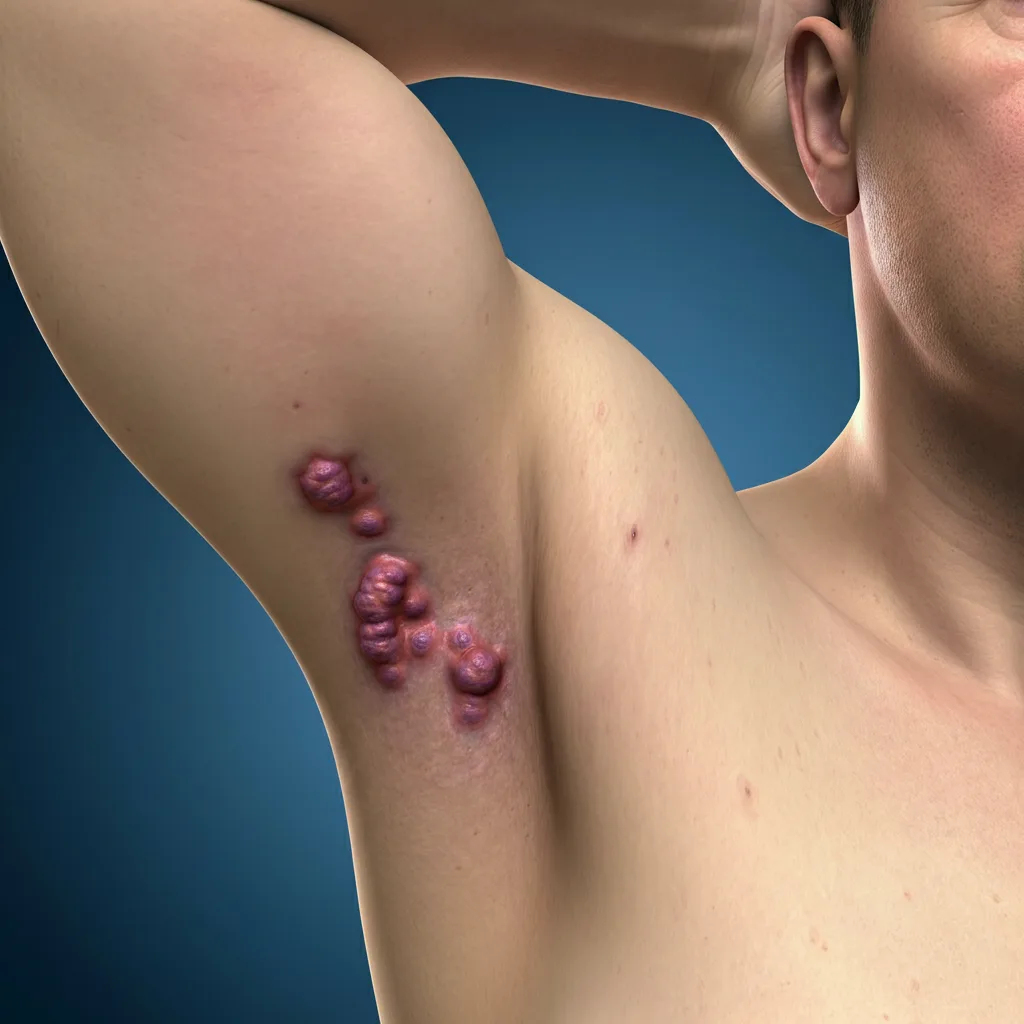
Input: affected anatomical region
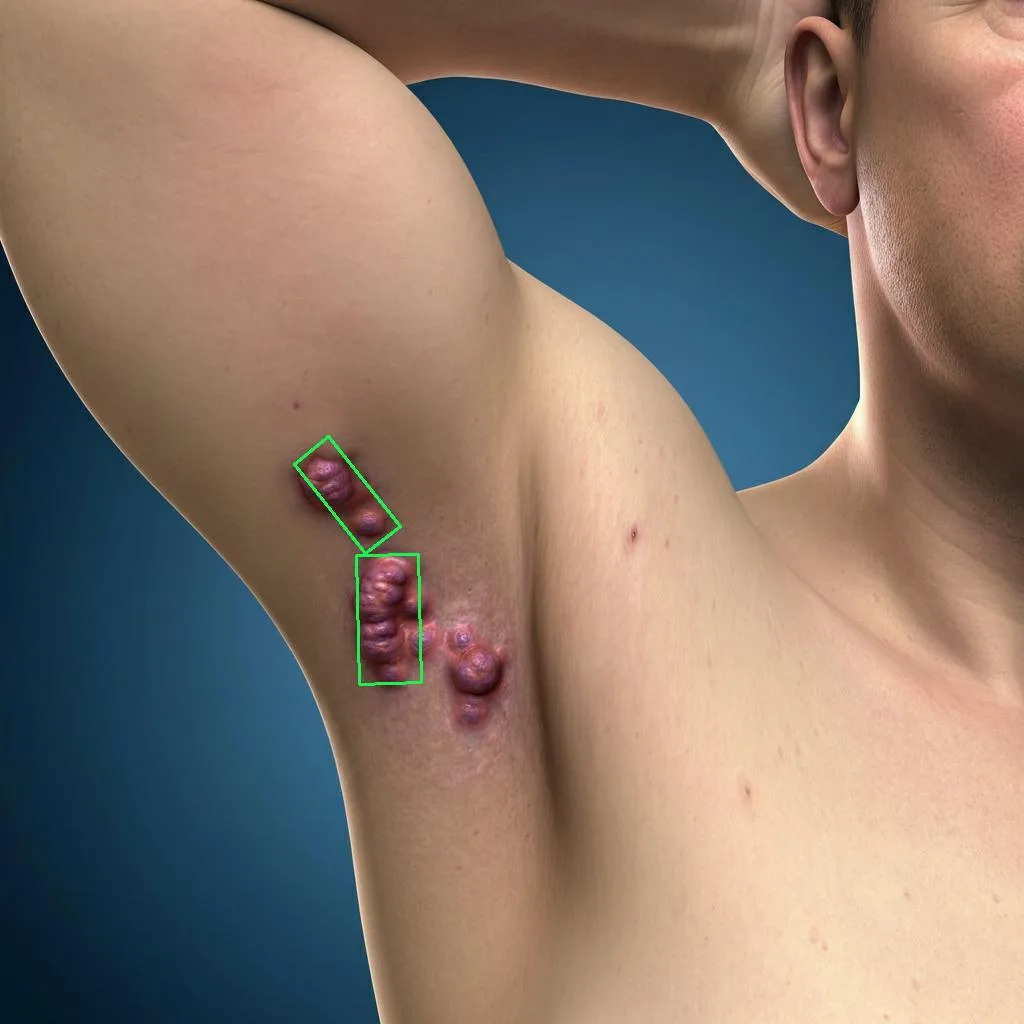
Output: colour-coded by type (papules, abscesses, fistulae)
Per-lesion-type count and weighted contribution
Anonymization
For anatomically sensitive areas, the platform applies automatic region-aware anonymization, ensuring patient privacy while retaining all lesion detection data.

Original capture of affected region

Privacy-preserving output with lesion data retained
Longitudinal IHS4 tracking
The platform tracks IHS4 evolution across visits with per-lesion-type breakdowns:
Baseline: AIHS4 score with per-lesion-type breakdown
Follow-up: IHS4 change and per-type lesion evolution
What longitudinal tracking delivers
- AIHS4 score trajectory: Score at every visit from screening to end of study
- Per-lesion-type counts over time: How nodules, abscesses, and fistulae evolve independently
- Severity classification transitions: Mild → Moderate → Severe (or reverse)
- Configurable alerts: Automated notification when IHS4 increases beyond threshold
Data export for EDC integration
All assessment outputs are structured for export:
| Field | Description |
|---|---|
| Patient ID | Pseudonymised study identifier |
| Visit ID | Visit number or scheduled timepoint |
| Timestamp | UTC timestamp of capture and processing |
| Nodule count | Total papules/nodules detected |
| Abscess count | Total abscesses detected |
| Fistula count | Total draining fistulae detected |
| Global AIHS4 score | Weighted composite |
| Severity classification | Mild / Moderate / Severe |
| Hurley stage | I / II / III estimate |
Data is transferred automatically via RESTful API or CSV/Excel export. Legit.Health provides IQ/OQ documentation and data mapping specifications.
Reliability of the scores
AIHS4 achieves ICC = 0.727 (95% CI: 0.66–0.79) — a 55% improvement over manual IHS4 inter-rater reliability (ICC 0.47). The AI produces the identical score for the same image every time, across every site, without calibration drift.
For the full validation evidence: Clinical Evidence →