Hidradenitis Suppurativa Severity Endpoints for Clinical Trials
The AI scoring provided by Legit.Health delivers automated, clinically validated severity assessment for hidradenitis suppurativa (HS) clinical trials, computing the AIHS4 (Automated IHS4) score aligned with the International Hidradenitis Suppurativa Severity Score System.
Why automated IHS4 for clinical trials?
The IHS4 (International Hidradenitis Suppurativa Severity Score) is a validated, count-based severity measure that quantifies lesion burden across anatomical regions:
Manual IHS4 scoring is subject to inter-rater variability in lesion identification and counting, particularly for distinguishing abscesses from nodules and identifying draining tunnels. AIHS4 automates this through deep learning lesion detection, providing objective, reproducible counts.
How the AI works
Lesion detection and classification
A deep learning object detection model identifies three lesion types:
| Lesion type | IHS4 weight | AI approach |
|---|---|---|
| Papules/nodules | ×1 | Object detection and classification |
| Abscesses | ×2 | Differentiated from nodules by visual features (fluctuance, erythema pattern) |
| Draining fistulae (tunnels) | ×4 | Tract and opening detection |
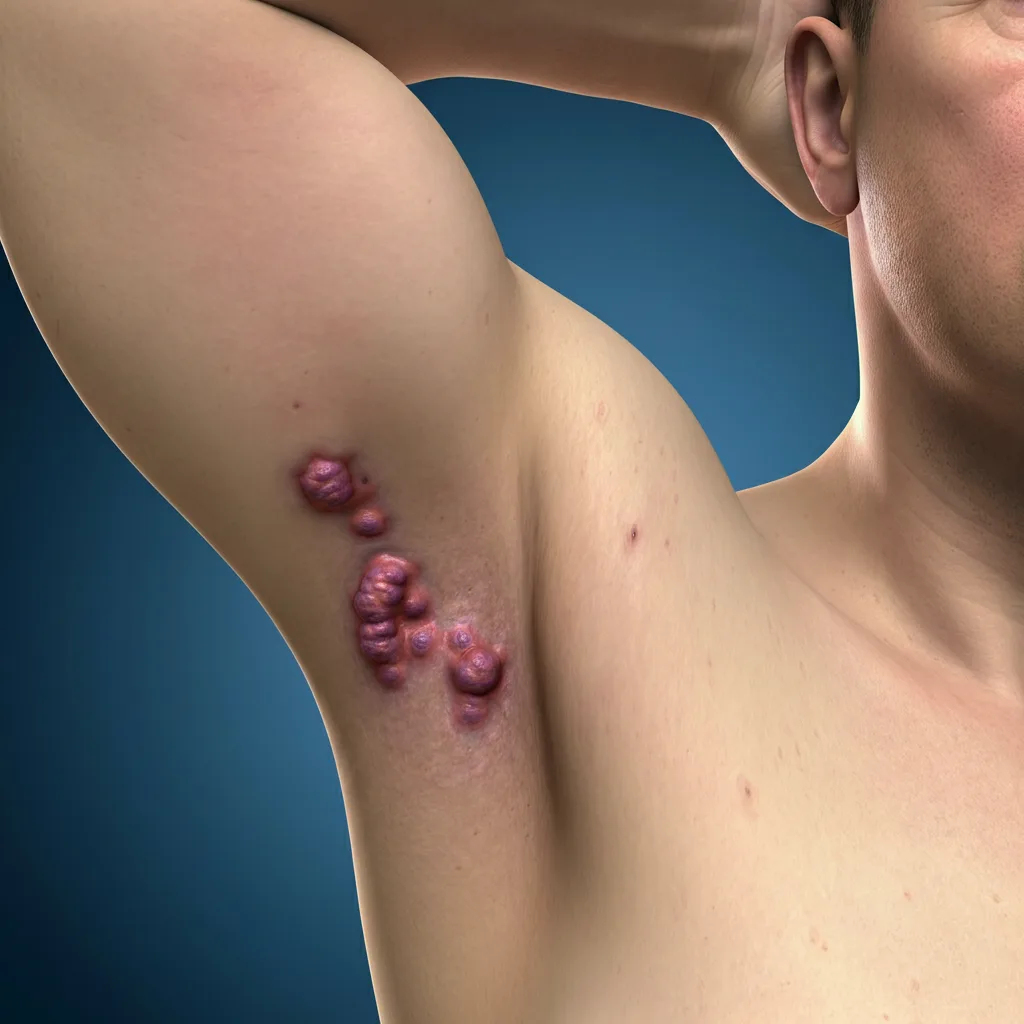
Input: affected anatomical region
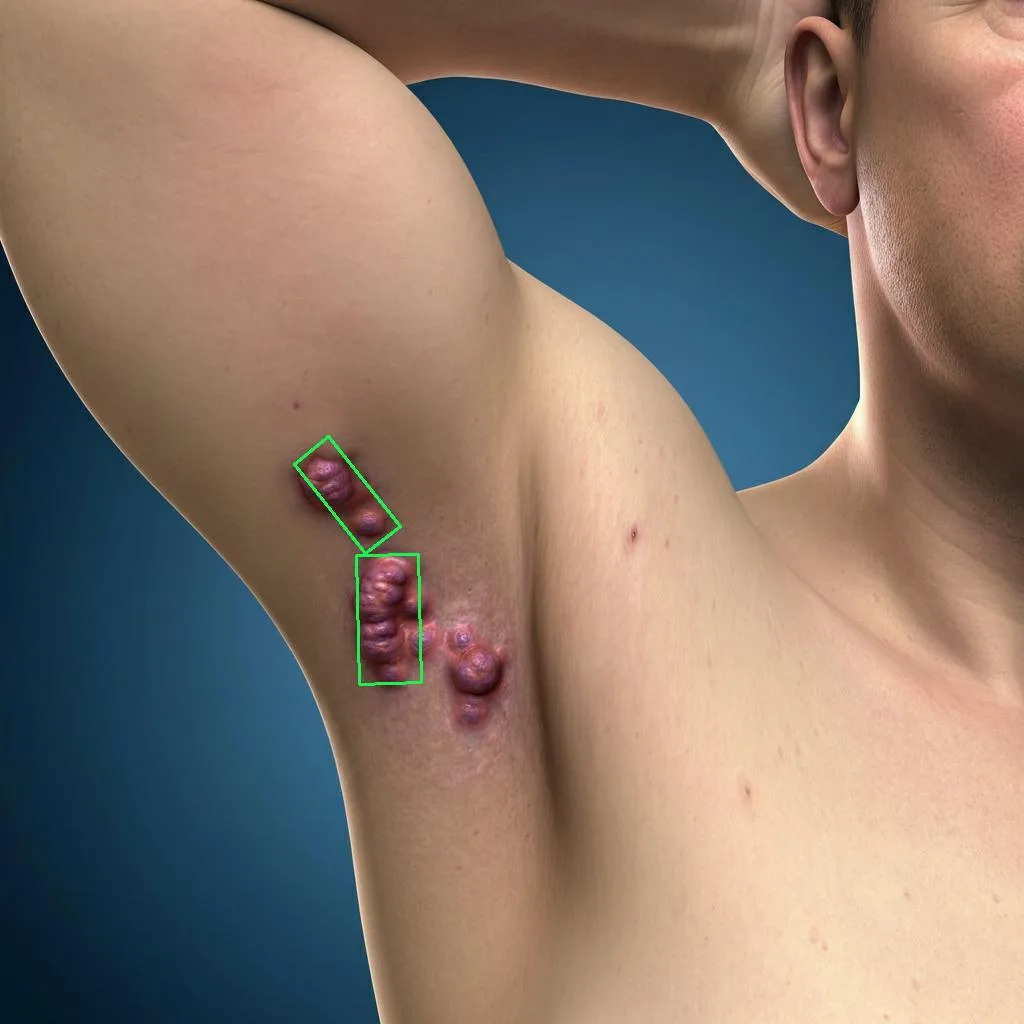
Output: bounding boxes by lesion type (colour-coded)
Papules (×1), abscesses (×2), fistulae (×4)
Severity classification
| IHS4 score | Severity |
|---|---|
| 0–3 | Mild |
| 4–10 | Moderate |
| ≥ 11 | Severe |
Validated reliability
AIHS4 achieves ICC = 0.727 (95% CI: 0.66–0.79) in the M-27134-01 clinical trial, substantially exceeding the manual inter-rater ICC of 0.47. See Clinical Evidence for full details.
Further reading
Scoring Methodology
Deep technical detail on the AIHS4 scoring pipeline—lesion detection and classification, IHS4 formula, Hurley staging, severity thresholds, and comparison with manual IHS4 assessment.
Imaging Protocol
Image capture protocols for hidradenitis suppurativa clinical trials, covering anatomical region photography, DIQA quality control, patient preparation, privacy-preserving anonymization, and site standardisation.
Clinical Evidence
Performance validation of AIHS4 hidradenitis suppurativa scoring, covering the M-27134-01 clinical trial results, ICC metrics, acceptance criteria, and the regulatory evidence pathway.
Trial Workflow
End-to-end clinical trial workflow for hidradenitis suppurativa severity endpoints, covering protocol design, patient enrollment, image capture, AI scoring, severity tracking, automated alerts, data export, and EDC integration.
Sample Outputs
Concrete examples of what sponsors, CROs, and investigators receive from hidradenitis suppurativa severity assessments—per-visit AIHS4 reports with lesion detection overlays, longitudinal tracking, anonymization, and structured EDC data exports.
Publications
AIHS4 validation study, key hidradenitis suppurativa severity assessment references, and the related clinical validation portfolio.
Limitations
Transparent documentation of what the AI hidradenitis suppurativa severity scoring can and cannot do, including detection challenges, scope boundaries, and how each limitation is managed.