Scoring Methodology
The platform from Legit.Health scores alopecia by measuring hair loss rather than estimating it: the software segments every pixel of four scalp photographs, measures the percentage of hair loss in each quadrant and combines the four into the SALT score, and the investigator reviews the report at the visit. The per-quadrant percentages are reported in their own right, so any responder definition the protocol needs comes from the same capture.
The example images on this page are synthetic dermatology imagery used for illustration; they are not patient records.
Hair loss segmentation
- Photograph: Four scalp quadrants.
- Segment: Hair, no hair or non-scalp per pixel.
- Measure: Hair loss % per quadrant.
- Weight: Each quadrant's share of the scalp.
- Score: Total SALT, 0 to 100.
A deep learning segmentation model, trained on scalp images annotated by several annotators and unified into a consensus reference, assigns every pixel of each photograph to one of three classes.
Hair
Scalp with visible hair coverage.
What the AI looks for: Hair strands and their texture over the scalp
No hair
Scalp exhibiting hair loss: patches, thinning to bare skin, or complete loss.
What the AI looks for: Exposed scalp skin inside the scalp boundary
Non-scalp
Background, face, ears, neck and clothing. Excluded from the calculation.
What the AI looks for: Everything outside the scalp boundary
From photograph to percentage
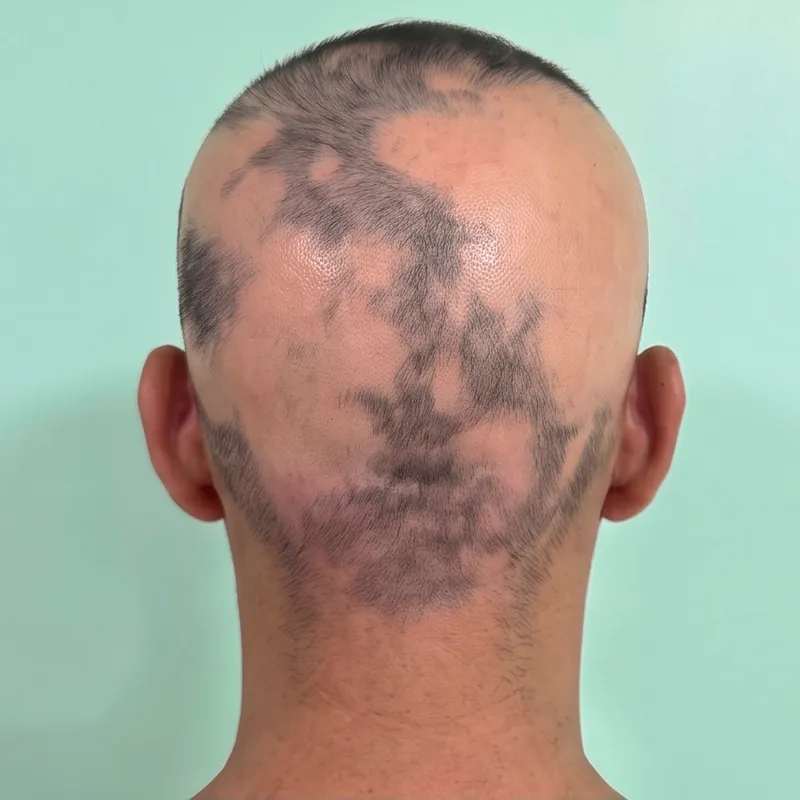
One scalp quadrant, captured at the visit
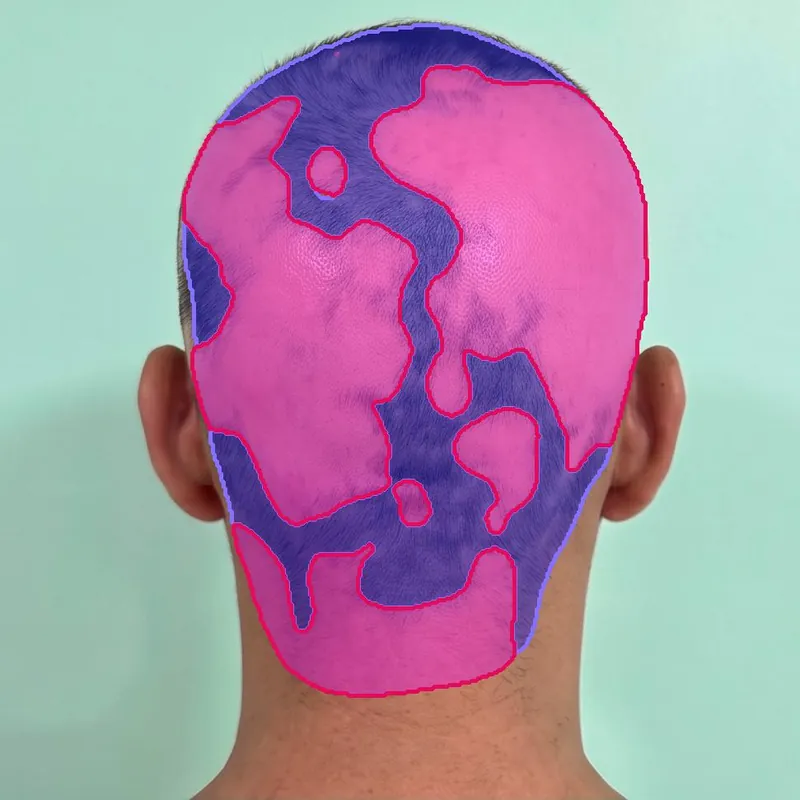
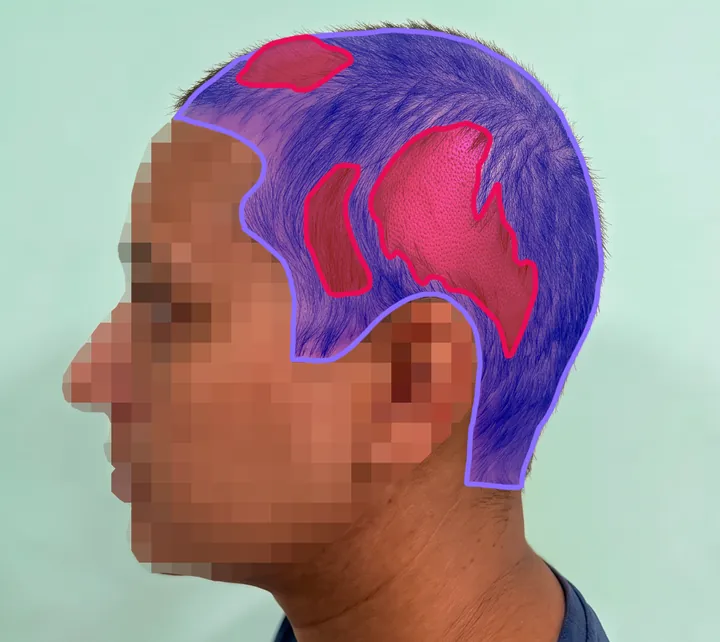
Hair in violet, hair loss in pink
No-hair pixels as a share of the visible scalp
For each quadrant , the hair loss percentage is the share of no-hair pixels within the visible scalp:
Non-scalp pixels are left out of both terms, so the background, the face and the ears never count as hair loss. Each pixel is assigned its most probable class, with no tunable threshold, so the same photograph always gives the same percentage.
SALT
The Severity of Alopecia Tool (SALT) was defined in the alopecia areata investigational assessment guidelines of the National Alopecia Areata Foundation (Olsen et al., 2004, Journal of the American Academy of Dermatology). It is the standard measure of the extent of scalp hair loss in alopecia areata trials.
SALT divides the scalp into four quadrants and weights each by its share of the total scalp area:
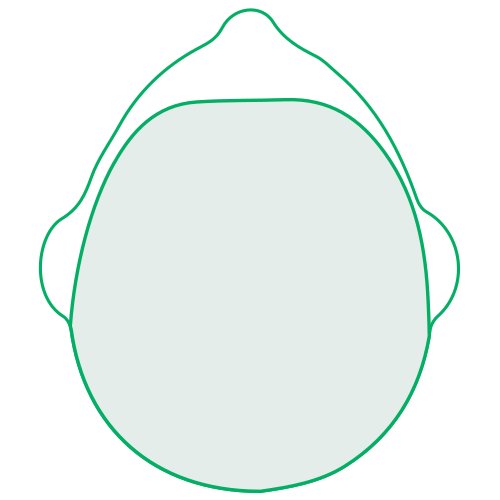
Top40%
Vertex and crown, the largest region of the scalp
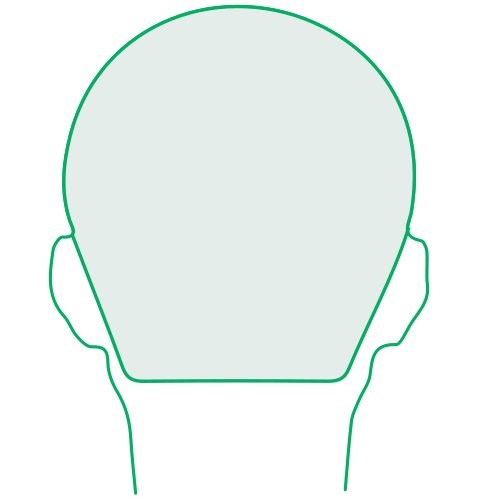
Back24%
Posterior scalp, from the occiput to the nape
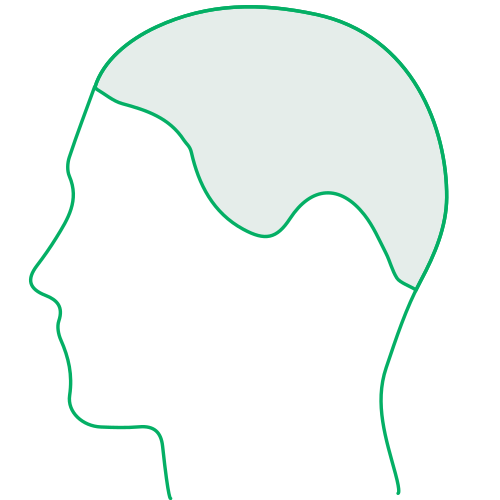
Left side18%
Left lateral scalp, above and around the ear
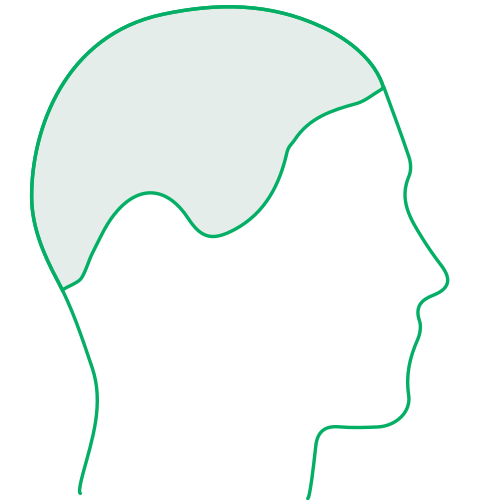
Right side18%
Right lateral scalp, above and around the ear
The total score is the weighted sum of the four quadrant percentages:
where each is the hair loss percentage of that quadrant. The score runs from 0, no hair loss, to 100, complete loss of scalp hair. Because of the weights, the same loss counts more on the top of the scalp: 50% hair loss on the top adds 20 points, while 50% on one side adds 9.
SALT quadrant weights. Together the four quadrants make up the whole scalp.
Severity bands
SALT itself is a continuous score. The original SALT guidelines group it into ordinal grades from S0 to S5 without descriptive labels, and there is no single agreed classification of alopecia areata severity (King et al., 2022). The platform uses the categories of the Alopecia Areata Investigator Global Assessment (AA-IGA), which gives each range of the total SALT score a clinical label (Wyrwich et al., 2020). Its upper limit for limited hair loss, SALT 20, is the same threshold used to define treatment success. A protocol can set different cut-offs during study design, for example for severity-based inclusion criteria.
AA-IGA severity categories of the total SALT score. A score of 0 means no hair loss.
SALT response thresholds
SALT scores one visit. Response to treatment is read from the same score, either as an absolute threshold or against the patient's baseline visit. A patient achieves a response at a visit when its condition below is true:
- SALT 20 or less: 20% scalp hair loss or less at the visit. An absolute threshold: it does not need the baseline.
- SALT 50: The SALT score at the visit is at least 50% lower than at baseline.
- SALT 75: The SALT score at the visit is at least 75% lower than at baseline.
- SALT 90: The SALT score at the visit is at least 90% lower than at baseline.
Clinicians and patients regard reaching 20% scalp hair loss or less as treatment success for patients with extensive hair loss (Wyrwich et al., 2020). Because every visit is scored on the same continuous scale, these definitions are derived directly from the per-visit scores, with no re-scoring.
A worked example
An illustrative example, not study data: the same patient followed across a 36-week trial, with an assessment every 12 weeks. The per-quadrant percentages are measured on the four photographs of each visit; the SALT score combines them, and the thresholds show when the patient reaches each response.
SALT by visit
Against the SALT 50 and SALT 20 thresholds
SALT contribution by quadrant
Points each quadrant adds to the total
| Hair loss per quadrant | Baseline | Week 12 | Week 24 | Week 36 |
|---|---|---|---|---|
| Top (40%) | 90% | 70% | 35% | 15% |
| Back (24%) | 60% | 40% | 20% | 10% |
| Left side (18%) | 29% | 22% | 15% | 10% |
| Right side (18%) | 65% | 45% | 25% | 10% |
| SALT | 67.3 | 49.7 (−26%) | 26 (−61%) | 12 (−82%) |
| SALT 20 or less | Reference | Not yet | Not yet | Achieved |
| SALT 50 | Reference | Not yet | Achieved | Achieved |
| SALT 75 | Reference | Not yet | Not yet | Achieved |
| SALT 90 | Reference | Not yet | Not yet | Not yet |
The patient reaches SALT 50 at week 24, and SALT 75 and SALT 20 or less at week 36, while SALT 90 is not yet reached. The top of the scalp drives most of the change: it weighs 40%, so its regrowth from 90% to 15% hair loss removes 30 of the 55 points the score falls. The photographs below show the left side of the same scalp at the first and last visits.
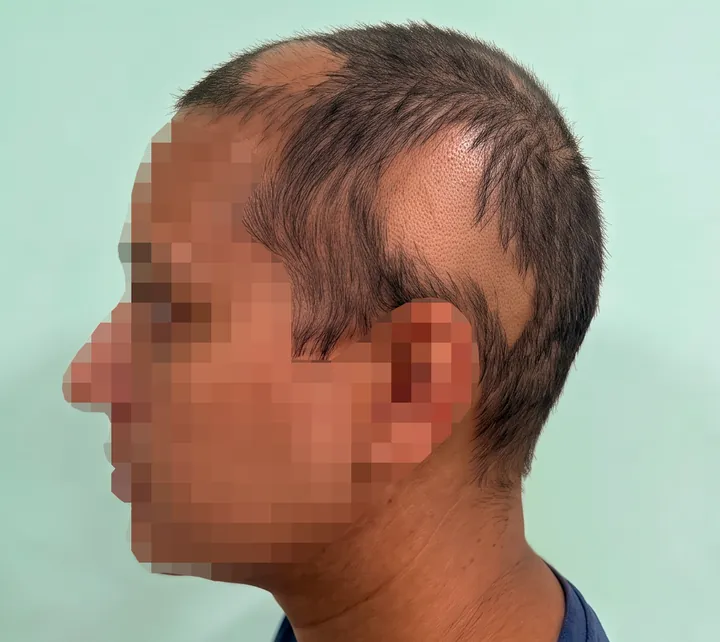
Left side, 29% hair loss
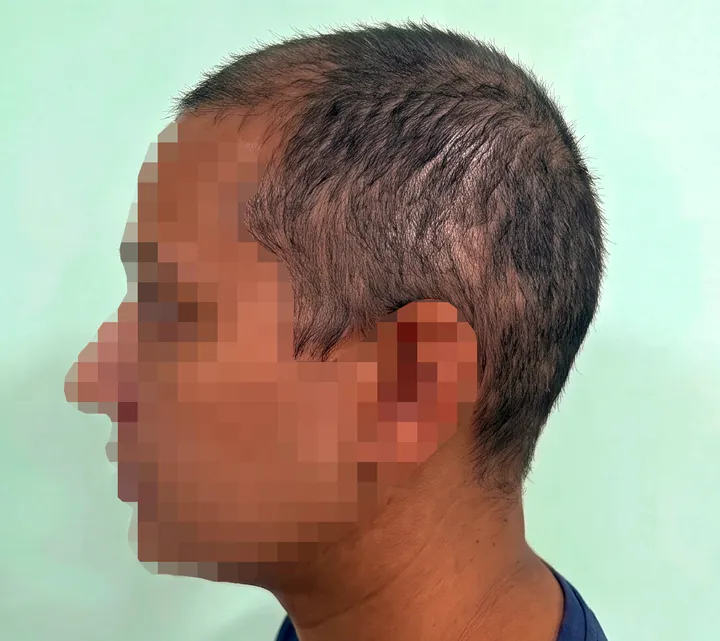
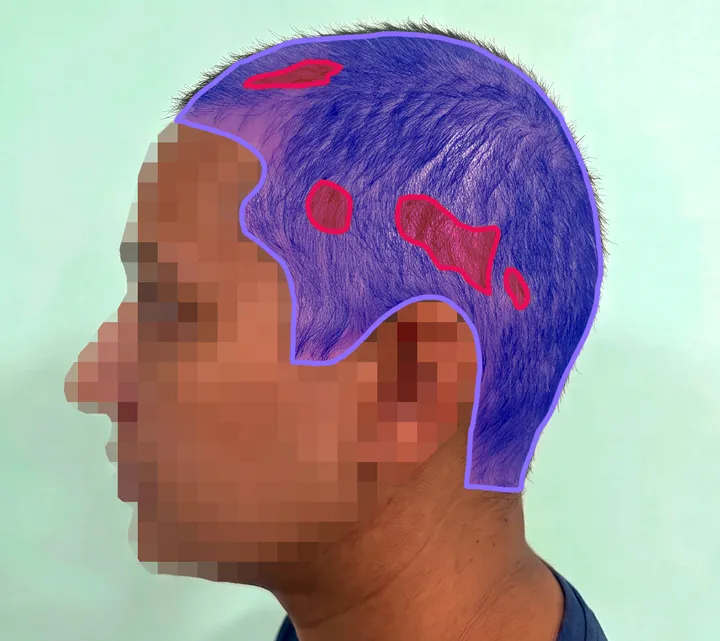
Left side, 10% hair loss
Drag the slider to compare the segmentation with the original photograph.
Manual vs. automated scoring
| Manual scoring | Automated scoring | |
|---|---|---|
| SALT estimated by a clinician | Pixel-level segmentation of four photographs | |
| Hair loss per quadrant | Estimated by eye | Measured from the pixels of each photograph |
| Resolution | Coarse steps, often rounded | Continuous percentage |
| Reproducibility | Depends on the rater and varies across sites | Same score for the same image, every time |
| Training | Calibration exercises to align raters | Following the capture protocol instead of calibrating estimates |
| Time per assessment | Four quadrants examined and estimated at every visit | Seconds of AI analysis, plus capture of four photographs |
The model version is locked at study initiation, so every patient is scored by the same model from first visit to last; see model version locking. The validation of the model is on Clinical evidence.
The AI reads hair loss from what the photograph shows. Shadows, partings and very light hair on a pale scalp can look like hair loss, and the model measures the extent of hair loss without identifying its cause; see Limitations.