Hidradenitis Suppurativa Severity Endpoints for Clinical Trials
The Legit.Health platform automates hidradenitis suppurativa severity scoring for clinical trials. It detects and counts inflammatory nodules, abscesses and draining tunnels to compute the International Hidradenitis Suppurativa Severity Score System (IHS4) and the Hidradenitis Suppurativa Clinical Response (HiSCR).
The device supports interventional and observational studies across all clinical trial phases, from Phase I to Phase IV, as well as real-world evidence (RWE) and post-marketing studies.
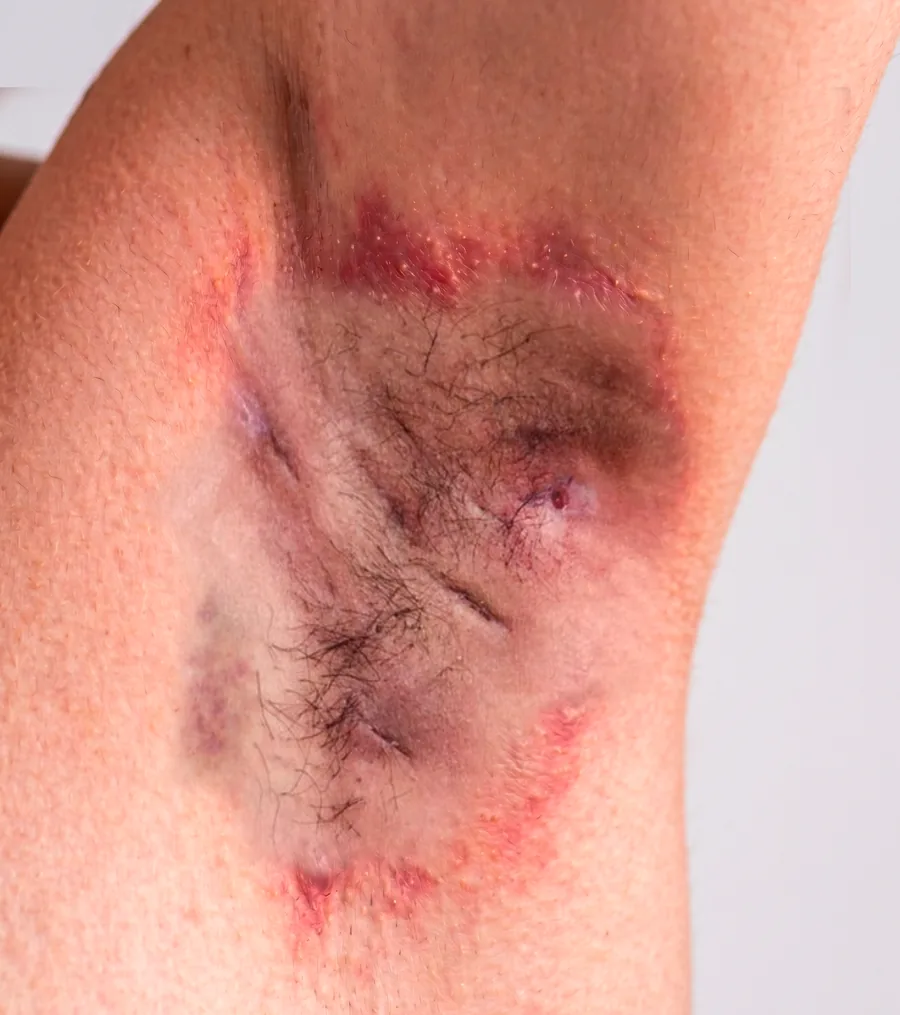
Original photograph
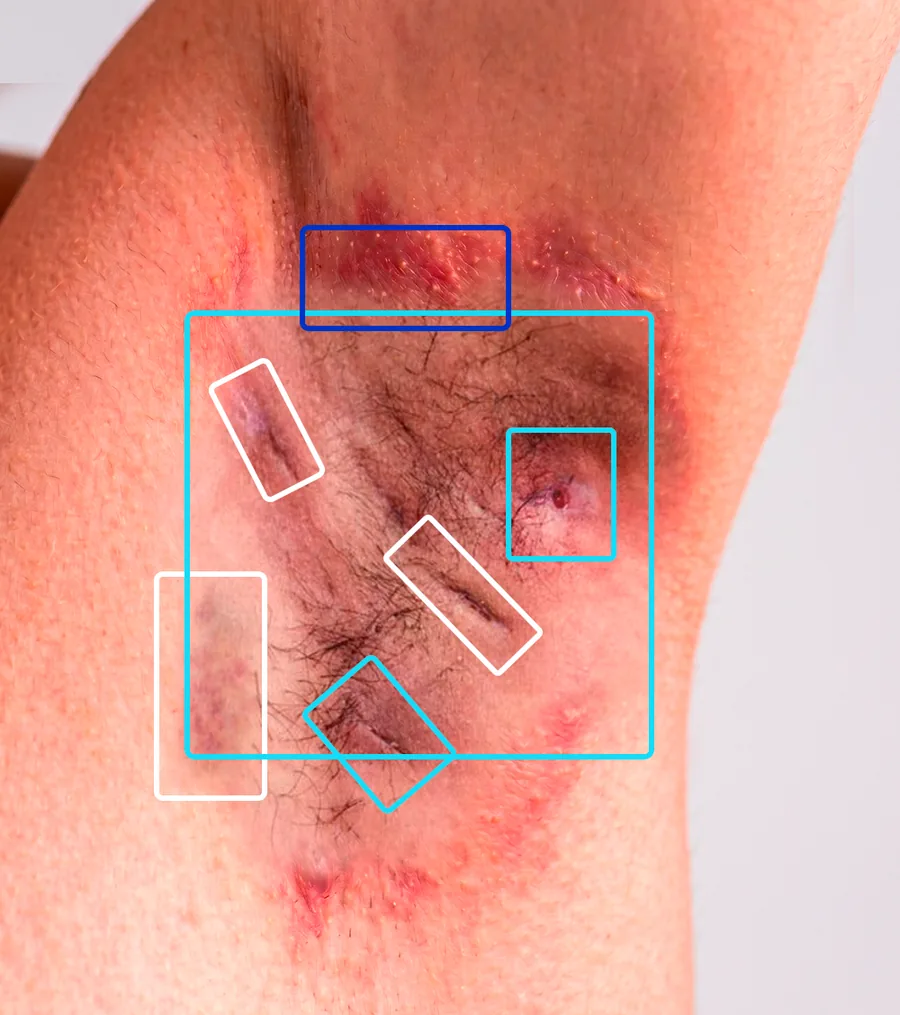
AI analysis
Automated IHS4
IHS4 17
Analysis performed in
1.26 seconds
These automated scores are backed by peer-reviewed validation; see Clinical evidence.
The example images on this page are synthetic dermatology imagery used for illustration; they are not patient records.
Why automated IHS4 for clinical trials?
Manual IHS4 asks an investigator to find, classify and count every nodule, abscess and draining tunnel in every affected region at every visit. Telling an abscess from a large nodule, or spotting a tunnel opening in a skin fold, is where independent raters disagree most, and each disagreement moves the score by 1 to 4 points.
The AI supports every step of the count:
- Lesion detection and classification: every lesion in the photograph found and classified with one consistent boundary, at every site and every visit
- DIQA (Dermatology Image Quality Assessment): image quality checked at capture, so substandard images are retaken at the visit rather than surfacing as missing data at database lock
Photographs are taken at the site, and only of the regions with lesions; see Imaging protocol.
Endpoint capabilities
The platform reports two measures from the same lesion counts, each configurable per study protocol:
- Composite
- 0 upwards
- Nodules ×1, abscesses ×2, draining tunnels ×4, with no maximum
- Severity
- 3 bands
- Mild 0 to 3, moderate 4 to 10, severe 11 and above
- Response
- Achieved or not
- Reduction in abscesses plus nodules (AN count) from baseline
- Thresholds
- 50, 75, 90
- HiSCR 50 by default, with stricter versions per protocol
How the AI works
- Detect and classify: A deep learning model finds every lesion in the photograph and classifies it as an inflammatory nodule, an abscess or a draining tunnel.
- Preliminary score: The lesion counts give a preliminary IHS4 and, against the baseline visit, HiSCR, shown to the investigator.
- Investigator review: The investigator examines the patient and confirms, corrects or adds lesions in the annotation interface.
- Final score: IHS4 and HiSCR are recalculated from the investigator's annotations. These are the reported values.
Unlike psoriasis or atopic dermatitis, hidradenitis suppurativa is scored by counting lesions rather than by measuring affected area, so no calibration markers or full-body photographs are needed. See Scoring methodology for the IHS4 formula, the severity bands and a worked example.
Longitudinal severity tracking
From the follow-up visits onward, the same report shows how the disease evolves across the study:
- IHS4 trajectory: the score at every visit, with its severity band, from screening to end of study
- HiSCR against baseline: whether the patient has reached HiSCR 50 or HiSCR 75 at each visit
- Per-lesion-type trends: how nodules, abscesses and draining tunnels change independently
- Protocol adherence: whether assessments are captured at the correct intervals
For follow-up visits, the platform charts this severity evolution across all assessments for the patient:
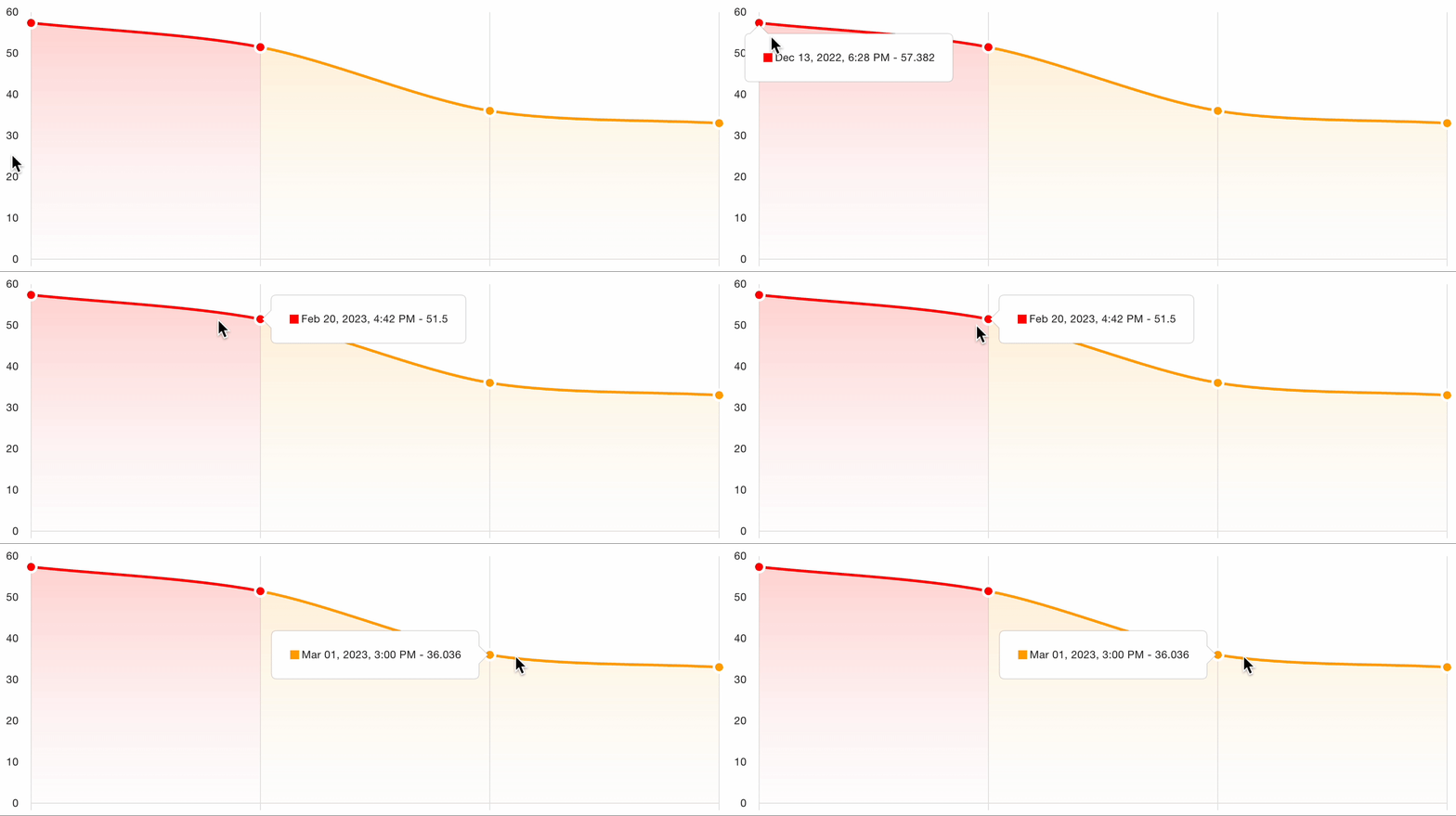
See the worked example for a patient followed across 48 weeks.
The platform provides automated severity scoring as decision support. Scores are interpreted by qualified healthcare professionals within the patient's overall clinical context; the platform does not replace clinical judgement or make autonomous diagnostic decisions.
Further reading
Scoring Methodology
Technical detail on how automated lesion detection and counting produce IHS4 and HiSCR for hidradenitis suppurativa, covering lesion classification, the IHS4 formula, severity thresholds, HiSCR against baseline, and comparison with manual assessment.
Imaging Protocol
How hidradenitis suppurativa images are captured for automated IHS4 and HiSCR: the standard capture regions, photographed only where there are lesions, framing and lighting rules, DIQA quality control, patient preparation and anonymisation.
Clinical evidence
Peer-reviewed publication behind automated IHS4 scoring for hidradenitis suppurativa, covering the AIHS4 study, the DIQA image quality gate, and the foundational IHS4 and HiSCR references.
Trial Workflow
End-to-end clinical trial workflow for hidradenitis suppurativa severity endpoints, covering protocol design, site setup, patient enrolment, in-clinic image capture, automated IHS4 and HiSCR, and EDC data export.
Limitations
Transparent documentation of what the automated IHS4 scoring for hidradenitis suppurativa can and cannot do, including the constraints of photograph-based lesion counting and how each limitation is managed.