Scoring methodology
This page provides the technical detail on how Legit.Health computes the automated SCORAD and EASI scores for atopic dermatitis, from image input through to the final severity value. Both indices are built from the same two image-derived measurements, extent and intensity, so this page explains those first and then how each formula combines them.
The example images on this page are synthetic dermatology imagery used for illustration; they are not patient records.
Extent
Body surface area (BSA)
Body surface area, the extent of skin affected by eczema, is the foundation of both SCORAD and EASI. It is also the single largest source of variability in manual scoring, and the input the AI measures most precisely.
How the AI measures affected area
A deep learning segmentation model (DeepLabV3+ architecture) analyses each body area photograph and classifies each pixel as:
- Affected skin (eczematous lesion)
- Unaffected skin (normal or uninvolved)
- Non-skin (background, clothing, hair)
The percentage of affected skin relative to total visible skin area is computed per photograph. These per-image percentages are combined across all captured body areas using anatomical weighting to produce the total BSA (0–100%).
where, for each captured body region , and are the affected and total visible skin areas (in pixels), and is that region's anatomical weight (the weights sum to 1).
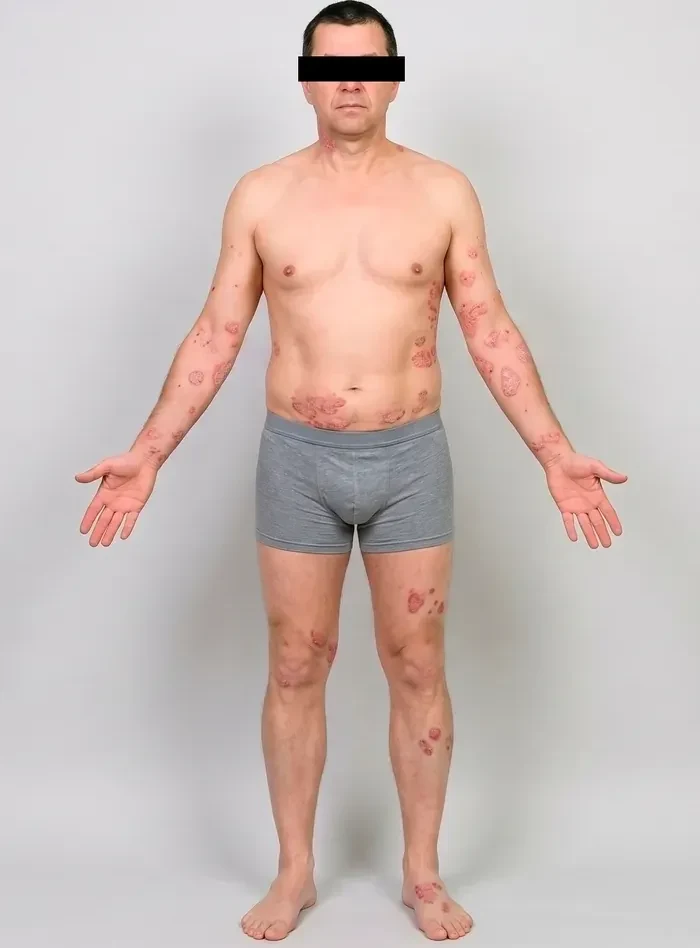
Input: body area photograph
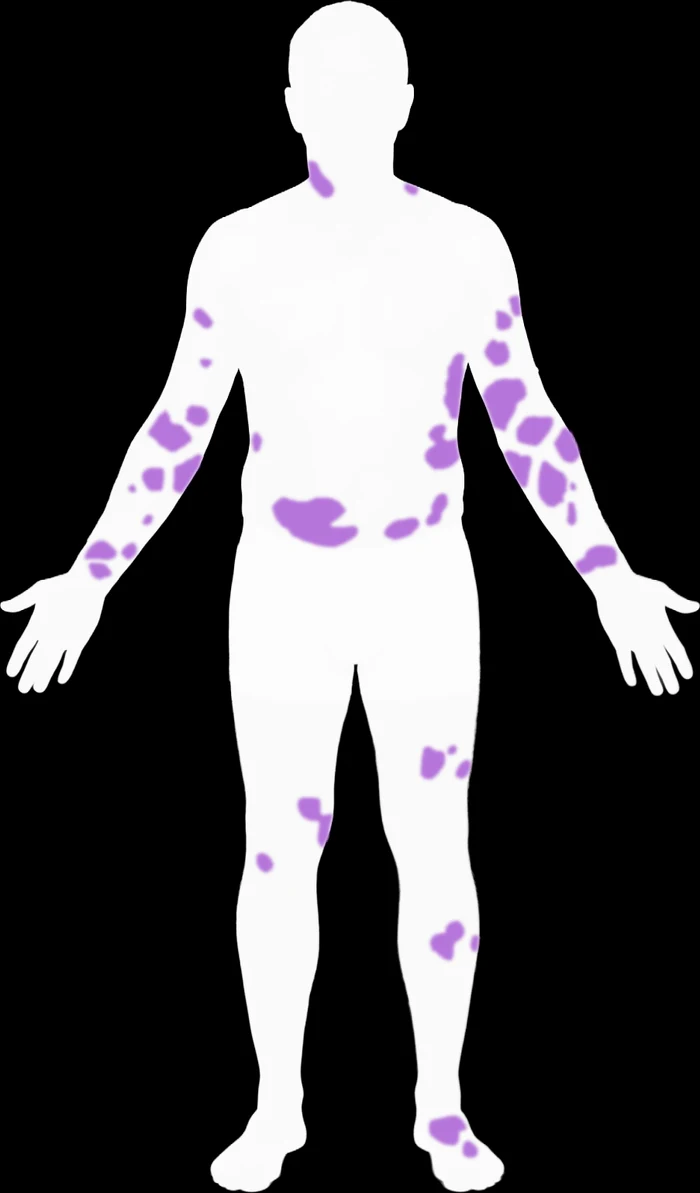
Output: affected areas detected across the body
In manual scoring, BSA is estimated using the "rule of nines", a coarse visual estimation method. This is the single largest source of inter-rater variability. Pixel-level segmentation replaces that estimation with an objective measurement, eliminating the most variable component of the manual score.
Intensity
Intensity scoring: the six clinical signs
Alongside extent, both indices grade the intensity of the disease signs on a 0–3 ordinal scale at the representative affected area. SCORAD grades six signs; EASI grades four of them (erythema, swelling, excoriation, lichenification) in each body region.
The six signs and what each one captures:
| Sign | Description |
|---|---|
| Erythema | Redness of the affected skin caused by inflammatory vasodilation, graded by how intense and widespread the red discoloration is. |
| Swelling | Swelling and small raised papules produced by fluid accumulation and inflammatory infiltrate in the dermis, graded by how elevated and palpable the lesions are. |
| Crusting (oozing/crusts) | Weeping of serous exudate from damaged skin together with the crusts that form as it dries, a marker of acute or secondarily infected lesions. |
| Excoriation | Linear erosions and scratch marks left by repeated scratching in response to itch, reflecting the intensity of disease-related pruritus. |
| Lichenification | Thickening of the skin with accentuated skin markings and a leathery surface, resulting from chronic scratching and rubbing over time. |
| Dryness | Xerosis, meaning roughness and fine scaling, assessed on skin away from active lesions, reflecting the impaired skin barrier typical of atopic dermatitis. |
For SCORAD, the intensity total is the sum of all six sign scores (0–18).
Subjective symptoms (pruritus and sleep) are separate from these signs: they are patient-reported, and EASI has no subjective component.
SCORAD
The SCORAD formula
SCORAD (SCORing Atopic Dermatitis) combines extent, intensity and subjective symptoms:
where:
- = Extent (affected body surface area, 0–100%)
- = Intensity (sum of six sign scores, each 0–3; total 0–18)
- = Subjective symptoms (pruritus NRS 0–10 + sleep disturbance NRS 0–10; total 0–20)
The maximum SCORAD is 103. The objective SCORAD (A/5 + 7B/2) has a maximum of 83, and this is what the AI computes. Subjective symptoms are patient-reported.
EASI
The EASI formula
The Eczema Area and Severity Index (EASI) is a co-accepted primary efficacy measure for AD, alongside SCORAD. EASI scores four signs (erythema, swelling, excoriation, lichenification) across four body regions, each weighted by regional BSA.
The maximum EASI is 72. Unlike SCORAD, EASI has no subjective component, so it is entirely image-derived.
Severity bands
Severity scale
Absent
Mild
Moderate
Severe
Very severe
Each sign is graded on the four levels from absent (0) to severe (3). The objective SCORAD (0–83), which is the part the AI computes, has three severity bands: mild below 15, moderate from 15 to 40 and severe above 40 (Oranje et al., 2007). The total SCORAD (0–103), once the patient-reported symptoms are added, uses mild below 25, moderate from 25 to 50 and severe above 50. EASI (0–72) has a fifth band, very severe, above 50, and a score from 0.1 to 1 is classed as almost clear (Leshem et al., 2015). Very severe does not apply to a single sign or to SCORAD.
Choosing an endpoint
SCORAD vs. EASI
| Aspect | SCORAD | EASI |
|---|---|---|
| Scale | 0–103 (objective 0–83) | 0–72 |
| What is scored | Extent + six signs + subjective symptoms | Four signs across four weighted regions |
| Patient-reported outcomes | Yes: pruritus + sleep NRS | No: purely objective |
| Regulatory acceptance | FDA and EMA accepted | FDA and EMA accepted |
SCORAD and EASI are computed automatically by the Legit.Health platform. The choice of primary and secondary endpoints is made during protocol design based on sponsor preference, prior precedent in the indication, and regulatory strategy.
Manual or automated
Manual vs. automated scoring
Manual scoring
SCORAD / EASI graded by a clinician
- BSA estimation: Visual rule of nines, ±15–20% variability
- Sign scoring: Subjective, 0–3 per sign
- Reproducibility: Inter-rater variability across sites
- Time per assessment: 5 to 10 minutes
Automated scoring
Automated SCORAD / EASI computed by Legit.Health
- BSA estimation: Pixel-level segmentation, objective
- Sign scoring: Objective AI, 0–3 per score
- Reproducibility: Identical score for identical image, every time
- Time per assessment: Under 2 seconds, plus 3 to 5 minutes of image capture
Because the platform scores from standardised photographs rather than a live examination, signs that a clinician might normally palpate, such as swelling, are read from visual cues. Each AI model is accepted only when it is non-inferior to expert inter-rater variability on the same photographs, so the AI is at least as consistent as dermatologists working from the same images.