Development and assessment of an artificial intelligence–based tool for scoring lesion severity in generalized pustular psoriasis clinical images


Published in JID Innovations, this peer-reviewed study introduces the automatic Generalized Pustular Psoriasis Physician Global Assessment (AGPPGA), an artificial intelligence-driven tool that scores pustulation, erythema, and scaling from clinical images of generalized pustular psoriasis (GPP), a rare and potentially life-threatening disease whose severity is difficult to assess consistently.
Sabater A, Medela A, Hernández Montilla I, Aguilar Robles SA, Mac Carthy T, Mollet Sanchez J, Baniandrés O, Izu-Belloso R, Mataix Díaz J, Rueda JM, Sanz-Motilva V, Chowdhry GSS, Semeco J, Martorell A. Development and assessment of an artificial intelligence–based tool for scoring lesion severity in generalized pustular psoriasis clinical images. JID Innovations. 2026;6:100521. https://doi.org/10.1016/j.xjidi.2026.100521
Summary
- Study type: Development and retrospective validation of an AI-based severity scoring tool
- Journal: JID Innovations (2026)
- DOI: https://doi.org/10.1016/j.xjidi.2026.100521
- Datasets: 2 datasets of GPP images, V1 (332 images) and V2 (4296 images from 46 patients), with diverse sexes, ages, and skin tones
- Reference standard: consensus of 2 panels of European-certified dermatologists with expertise in psoriasis and GPP (3 annotators for V1 and 4 for V2)
- Objective: Automatically assess the 3 visual signs of the GPPGA (pustules, erythema, and scaling) and compare the tool's agreement with the expert consensus against that of the dermatologists themselves
Background and rationale
Generalized pustular psoriasis is a rare, chronic, systemic inflammatory disease with an unpredictable and heterogeneous clinical course, characterized by pustules, erythema, and periods of flaring. Accurate assessment of disease severity helps physicians define treatment goals and evaluate treatment responses.
The GPPGA grades pustules, erythema, and scaling on a 5-point scale (0 = clear, 1 = almost clear, 2 = mild, 3 = moderate, and 4 = severe), and the overall score is the mean of the 3 components. Like other scoring systems, it is limited by the subjectivity of manual evaluation and the time it takes to complete, and these challenges are more pronounced for nondermatologist clinicians. AGPPGA was designed within the paradigm of augmented intelligence: not to replace clinical judgment, but to provide an objective and reproducible baseline that increases the confidence and consistency of clinicians who manage this rare disease.
Design
AGPPGA is a deep learning-based computer vision model that combines an image encoder (CAFormer-S), a multitask mixture of experts block, and 3 task-specific heads, one for each GPPGA visual sign. This design assesses all 3 signs from a single image while avoiding the loss of performance that can occur when one task interferes with another.
The model was trained and evaluated with 4-fold cross-validation on 2 datasets:
- V1: 332 lesion-centered images, 101 from the EFFISAYIL 1 clinical trial and the rest from public dermatology atlases, predominantly of light skin tones
- V2: 4296 high-resolution images of large body areas from 46 patients in the EFFISAYIL 2 clinical trial, predominantly of medium-to-dark skin tones, with strict patient-level partitions across folds
A third dataset of 50 images of healthy skin or nonspecific lesions was added to anchor the clear (GPPGA = 0) baseline. Performance was measured with accuracy, Cohen's kappa with quadratic weights, and mean absolute error (MAE) of the final GPPGA score.
Figure 5: Saliency maps calculated over images from the V1 and V2 datasets
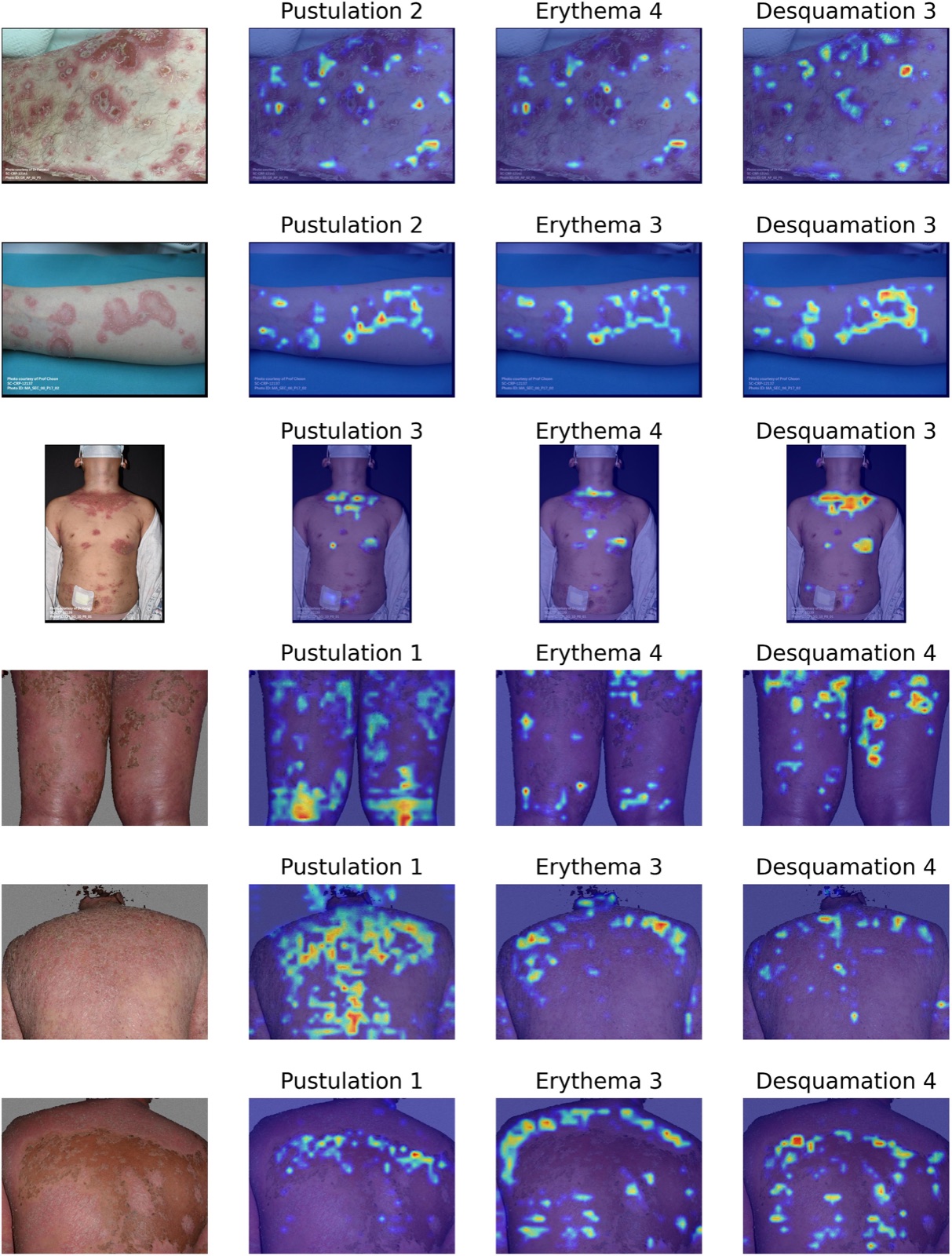
Each row shows an original clinical image followed by the saliency maps for pustulation, erythema, and desquamation (scaling), with the severity grade assessed by AGPPGA. The model consistently focuses on GPP lesions and their boundaries rather than on the background or other contextual artifacts, for example attending to lighter pixels to evaluate scaling and to the transition between healthy and erythematous skin to assess erythema.
Results
Agreement with the expert consensus
Table 1: Performance of AGPPGA and the dermatologist annotators with respect to the expert consensus
| Dataset | Evaluator | Accuracy | Cohen's kappa | GPPGA MAE |
|---|---|---|---|---|
| V1 | AGPPGA | 0.62 ± 0.04 | 0.74 ± 0.04 | 0.30 ± 0.01 |
| V1 | Dermatologists | 0.70 ± 0.01 | 0.79 ± 0.02 | 0.32 ± 0.02 |
| V2 | AGPPGA | 0.64 ± 0.02 | 0.82 ± 0.02 | 0.31 ± 0.01 |
| V2 | Dermatologists | 0.65 ± 0.02 | 0.80 ± 0.02 | 0.33 ± 0.02 |
Table 2: Cohen's kappa by GPPGA visual sign
| Dataset | Evaluator | Pustules | Erythema | Scaling |
|---|---|---|---|---|
| V1 | AGPPGA | 0.76 | 0.75 | 0.72 |
| V1 | Dermatologists | 0.78 | 0.80 | 0.79 |
| V2 | AGPPGA | 0.71 | 0.86 | 0.88 |
| V2 | Dermatologists | 0.68 | 0.86 | 0.86 |
In terms of statistical significance, AGPPGA was statistically indistinguishable from the aggregated expert panel on the more heterogeneous V1 dataset, and statistically significantly better on the more standardized V2 dataset, both for the aggregated visual signs and for the final GPPGA score. The vast majority of misclassifications fell into adjacent severity categories, so large, clinically dangerous errors such as classifying a severe case as clear were exceptionally rare.
Performance across patient demographics
Table 3: Performance in the V2 dataset stratified by patient sex and age
| Subgroup | Patients | Samples | AGPPGA Cohen's kappa | Dermatologists Cohen's kappa | AGPPGA GPPGA MAE | Dermatologists GPPGA MAE |
|---|---|---|---|---|---|---|
| Female | 32 | 760 | 0.80 | 0.78 | 0.29 | 0.33 |
| Male | 14 | 328 | 0.74 | 0.73 | 0.35 | 0.41 |
| Aged 21-34 years | 11 | 384 | 0.77 | 0.81 | 0.32 | 0.34 |
| Aged 35-49 years | 22 | 544 | 0.81 | 0.76 | 0.29 | 0.35 |
| Aged 50-66 years | 13 | 160 | 0.73 | 0.68 | 0.35 | 0.44 |
Table 4: Performance in the V1 and V2 datasets stratified by Fitzpatrick skin tone
| Dataset | Fitzpatrick skin tone | AGPPGA Cohen's kappa | Dermatologists Cohen's kappa | AGPPGA GPPGA MAE | Dermatologists GPPGA MAE |
|---|---|---|---|---|---|
| V1 | I-II | 0.74 | 0.78 | 0.30 | 0.31 |
| V1 | III-IV | 0.78 | 0.82 | 0.35 | 0.35 |
| V1 | V-VI | - | - | 0.17 | 0.33 |
| V2 | I-II | 0.68 | 0.74 | 0.31 | 0.34 |
| V2 | III-IV | 0.77 | 0.76 | 0.30 | 0.35 |
| V2 | V-VI | 0.81 | 0.77 | 0.32 | 0.37 |
Conclusions
AGPPGA achieved substantial agreement with expert dermatologists (Cohen's kappa of 0.74 or higher) and a precise GPPGA score calculation (MAE of 0.31 or lower) across visual signs and a diverse range of sexes, ages, and skin tones. Its performance was statistically indistinguishable from the expert panel on the V1 dataset and statistically superior on the more standardized V2 dataset.
The tool is intended for severity grading of GPP lesions, not for diagnosis, and its performance depends on the quality of the input images: good lighting, no motion blur, and high-resolution images taken at an appropriate distance so that small pustules remain visible. By providing objective and reproducible assessments, AGPPGA can support nonspecialists, reduce inter- and intraobserver variability among dermatology experts, and help standardize severity scoring in rare disease research and multicenter clinical trials.
Automatic GPPGA offers a reproducible method that can address the subjectivity of manual evaluation and facilitate the standardization of GPP severity assessment.