2026: certified for the whole of the skin.
This year Legit.Health became the first medical device certified under the EU Medical Device Regulation to support the diagnosis of every visible skin condition and to measure how severe it is. Around that certificate sit five more achievements: our information system certified at the highest category of the Spanish National Security Framework, a new version of the device that is more accurate than the last, clinical studies showing that clinicians diagnose better with it, an app with an AI assistant, and new indexes in the API.
Regulation
The first MDR certificate for every visible skin condition.
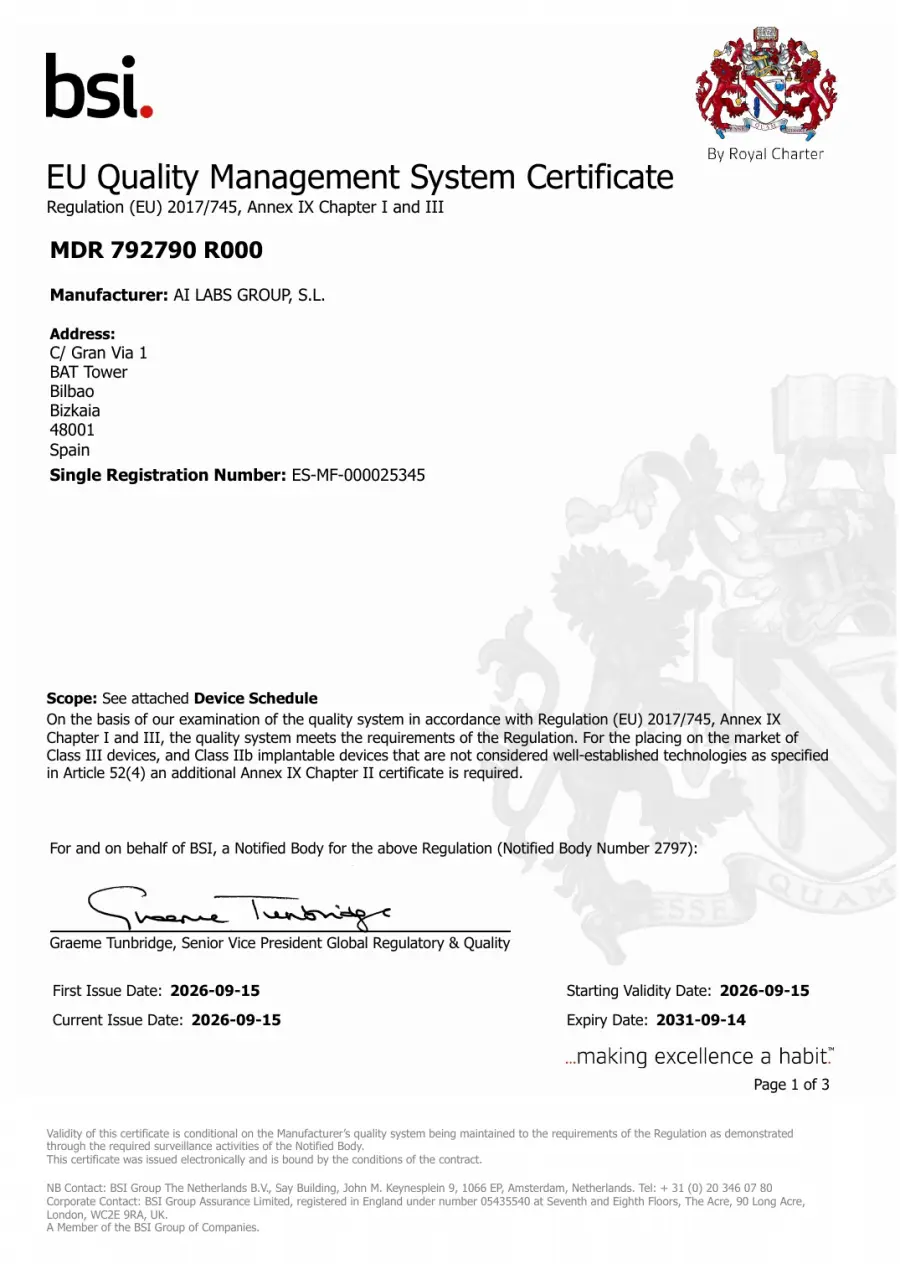
On 15 September 2026, BSI certified Legit.Health under the EU Medical Device Regulation as a Class IIb medical device. Its certified intended purpose does not name a single disease: it covers diagnosis support across the whole of the skin, its appendages and the associated mucous membranes, and the measurement of how severe a condition is. No other company holds an MDR certificate for that scope. It is also registered with ANVISA in Brazil and with the MHRA in the United Kingdom.
How it compares
Most certified dermatology AI is certified for skin cancer only. Set side by side with DERM by Skin Analytics, as each manufacturer states it in its own instructions for use, the difference is in who and what each device is for:
- Conditions: Legit.Health covers every disease of the skin; DERM covers lesions suspicious for skin cancer and excludes rashes, eczema, infections and lupus.
- Severity and follow-up: Legit.Health measures severity at each visit, so the response to treatment can be followed; DERM lists monitoring treatment and staging disease among its limitations.
- Children: Legit.Health is intended for adults and children; DERM is for patients aged 18 or over.
- Skin types: Legit.Health is intended for Fitzpatrick types I to VI; DERM was evaluated mostly on types I to IV and is to be used with caution on the others.
Legit.Health is intended for all six Fitzpatrick phototypes. DERM's instructions for use ask for caution outside types I to IV, which in practice means patients with darker skin.
The certification page has the full comparison, the certificate itself and why a system that integrates Legit.Health does not become a medical device of its own.
Security
Our information system, certified at the highest category.
In June 2026 the information system behind Legit.Health was certified against the Spanish National Security Framework (Esquema Nacional de Seguridad, ENS) in category High, the highest of its three categories, which is what Spanish public health services require of the systems that handle their patients' data. The certificate was issued by Applus+ and covers the information system that supports the design, development and maintenance of our diagnosis-support software.
The device
A new version, more accurate than the last.
The certified device is a new version of Legit.Health. IDEI_2023 is the one study that ran both versions on the same cases, pigmented lesions each confirmed by histopathology. The new version put the right condition first more often than the previous one, and among its first three more often too; within the first five the two were level.
| Diagnostic accuracy | Previous version | Legit.Health Plus |
|---|---|---|
| Top-1 | 71.43% (20/28) | 78.57% (22/28) |
| Top-3 | 82.14% (23/28) | 89.29% (25/28) |
| Top-5 | 89.29% (25/28) | 89.29% (25/28) |
In patients referred to dermatology
In DAO_Derivación_O_2022, a study of real patients referred from primary care to dermatology, Legit.Health correctly ruled out malignancy in 93.53% of benign lesions and flagged 57.14% of malignant ones; when it flagged none, the lesion was benign in 96.00% of cases. The malignant cases in the study were few, so these figures are a first measure rather than a final one. The study page has the detail.
Other metrics
Accuracy is one measure. These are three more of the new device, from its validation before release.
- ICD-11 categories in the differential
- 346
- From the common to the rare, each with its code.
- AUC for malignancy
- 0.92
- On images it never saw in training.
- Agreement with experts on image quality
- 0.90
- Pearson correlation with expert ratings of the same photographs.
Evidence
Clinicians diagnose better with Legit.Health.
Four reader studies asked the same question: when the same clinicians read the same images of real cases, first on their own and then with Legit.Health, how much more often do they get the diagnosis right? Each one found a gain. In every study that compared the two groups, the gain was larger for primary care physicians, who start from a lower baseline and are the first to see most skin conditions.
- in primary care physicians' diagnostic accuracy
- Up to +28 points
- of diagnoses right first time by primary care physicians
- Up to 90%
- in dermatologists' diagnostic accuracy
- Up to +16 points
Primary care physicians
Dermatologists
The studies
- MAN_2025, dark skin: Every one of its 149 cases was a Fitzpatrick type V or VI presentation, the skin types that most datasets under-represent. With Legit.Health, readers of every specialty together, nurses included, named the right condition first in 65.07% of cases.
- SAN_2024, a wide range of conditions: Primary care physicians and dermatologists diagnosed cases across thirteen conditions, from the common to the rare. Read the study.
- BI_2024, generalised pustular psoriasis: A rare condition that is easily mistaken for others, among cases of the conditions it is confused with. Published in JMIR Dermatology in 2026. Read the study.
- PH_2024, primary care: General practitioners at a primary care centre, on the skin lesions they see every week. Read the study.
Publications
Peer-reviewed, and published this year.
The evidence does not stay in our files. Four studies were published in 2026 in peer-reviewed dermatology journals, from diagnosis support in a rare disease to automated scores of how severe a condition is.
A multi-reader study of how Legit.Health helps clinicians recognise a rare and severe form of psoriasis.
An automated severity score for generalised pustular psoriasis, calculated from clinical photographs.
The Acne Lesion And Density INdex, an automatic measure of how severe acne is.
Measuring the area of a lesion from a single photograph, without a ruler.
The app
An AI assistant beside the report, not in place of it.
The app, which customers embed in their own systems, now includes an AI assistant for the two moments where people most often need help: taking a photograph that can be assessed, and understanding the report. It is separate from the medical device. It never diagnoses, never recommends a treatment and never changes the medical result.
What is new
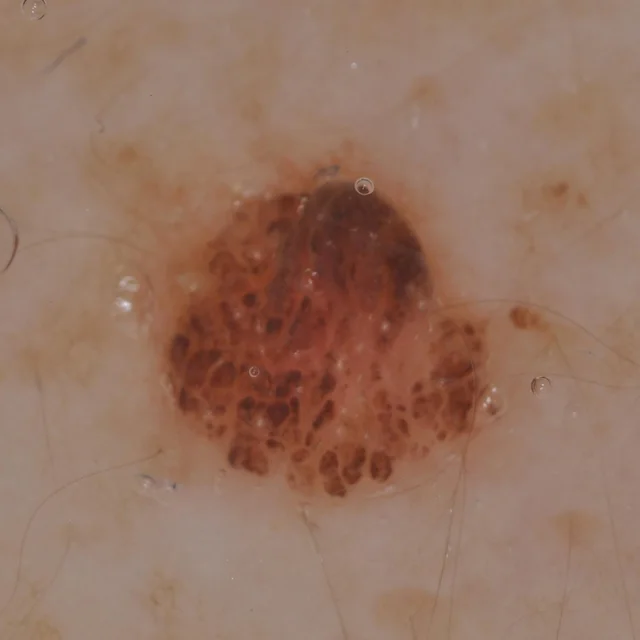
It checks focus, light, framing and distance, and that the photo matches the body site, and offers a retake on the spot instead of a refused photo later.
It finds the affected skin and suggests a crop when the lesion is small or off-centre in the frame.
A short explanation inside each section of the report, for clinicians: the indexes, the differential and the severity score.
Clinicians ask about the report, for example what the top result means, and the answers stay within the report and skin health.
Also new
- Why a photograph was refused: when the device's quality check refuses a photograph, it says in plain words what to change.
- Consistency check: it takes a second look at the photographs against the report and offers a retake when they do not match.
- Dermoscopy check: it flags a photograph analysed as a dermoscopic image that shows neither a pigmented lesion nor a skin tumour.
- Under your control: each step is switched on or off from the URL, like the rest of the app, and if the assistant is unavailable the report is shown as usual. The PDF of the report never contains the assistant's text. The implementation page explains how.
The API
New indexes that help decide what to do next.
The new device returns more than a ranked differential. Each index is a probability from 0 to 100, so each can sit behind a threshold you choose, and the app shows them for you; the features page shows each one in the interface.
- Entropy: how spread out the differential is. It is low when one condition clearly leads and high when several are about equally likely, so an uncertain case can go to a person instead of down an automatic pathway. New in this version.
- Referral probabilities: how likely the case needs an urgent referral, within 48 hours, and how likely it needs a high-priority one, each in low, moderate and high bands, for triage and waiting-list priority. New in this version.
- Condition present: whether the photograph shows a skin condition at all, read before anything else.
- Malignancy probability: how likely the lesion is malignant, shown as a gauge with the same bands, for fast-track pathways.
- Six safety indicators: whether the case is malignant, pre-malignant, associated with malignancy, pigmented, or needs an urgent or a high-priority referral, each always visible. New in this version.
{ "identifier": "a9ae9e81-…", "imageAnalyses": [ { "technicalSummary": { "imageQuality": { "score": 7.4, "interpretation": "good" } } } ], "studyAggregate": { "findings": { "hypotheses": [ { "identifier": "psoriasis", "probability": 84.2 }, … ], "entropy": 22.1, "riskMetrics": { "urgentReferralProbability": 4.1, "highPriorityReferralProbability": 62.0, "malignantConditionProbability": 1.2 } } }}
- Quality: Whether each photograph can be assessed and how good it is, so a poor one is retaken before anything else is read.
- Diagnosis: The conditions the photographs may show, ranked by probability, and how certain that ranking is.
- Referral: How likely the case needs a specialist and how likely the lesion is malignant, to set its priority and its pathway.
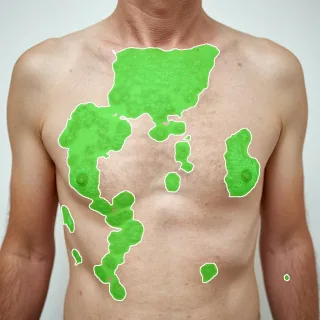
- Severity: The intensity and the extent of each clinical sign, to grade the condition and follow it from one visit to the next.
Get started
AI-powered dermatology validated by peer-reviewed research. Trusted by leading hospitals across Europe. Fill in the form to see how our CE-marked platform can transform your practice.