Regulatory perspective on the VASI
Regulators accept the VASI as the efficacy measure for vitiligo, and they have also set out its weaknesses. This page summarises what the FDA said about it, how protocols define it, and what a sponsor should pre-specify when the automated VASI from Legit.Health is part of a trial.
The precedent
The VASI in an FDA approval
In 2022 the FDA approved a topical treatment for nonsegmental vitiligo on two phase 3 trials with 673 patients. The primary endpoint was F-VASI75 at week 24, a reduction of at least 75% in the facial VASI (FDA review, page 15). The investigator scored the VASI at the visit, estimating each area in hand units, with the patient's palm and five digits as 1% of the body surface (registration).
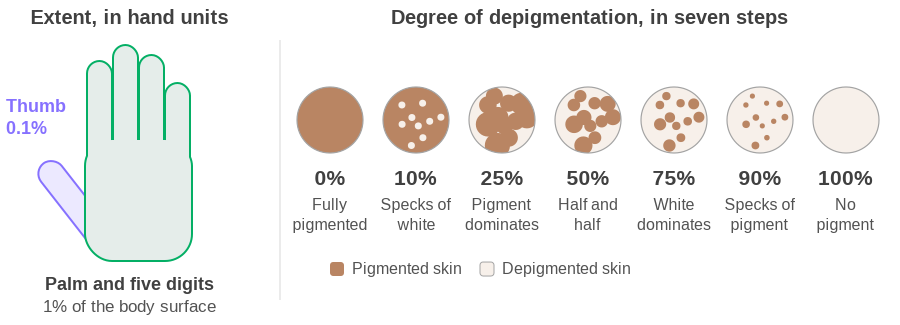
What the investigator estimates by eye: the extent of each area in hand units, and how much of it has lost its pigment, in seven steps. Illustration
The FDA review
What the FDA review says
The FDA review accepted the VASI for labelling claims on the face and the total body, and recorded five concerns about how it is scored:
The investigator grades depigmentation in seven fixed steps and rounds the result. On a small area such as the face, one step up or down moves the score a lot, and the FDA saw this as a source of inaccuracy.
Two investigators can give the same patient different scores, and how much they disagree was never measured. The FDA could not tell whether clinicians read the scale the same way.
To limit that disagreement, the protocols asked one investigator to score each patient for the whole study. Over a year of visits, holidays, staff changes and several sites make that hard to keep.
The VASI values went into the study datasets without being written down in case report forms, so the reviewers could not check them against a source record.
The VASI adds several body sites into one number. That makes it hard to say what a given change means for the patient, or to turn it into a claim on the label.
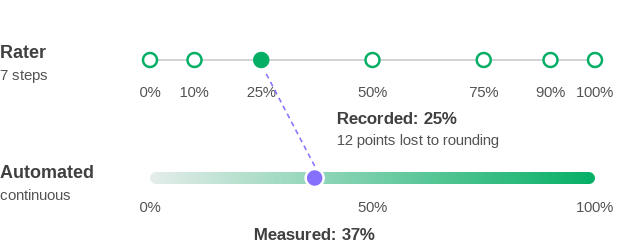
The rater rounds the depigmented share to the nearest of seven steps; the automated measurement keeps the measured value. Illustrative values
The review also noted that the original validation of the VASI did not cover the face, and asked for evidence of reliability, validity and interpretability. An automated VASI used as an endpoint needs the same evidence; its status is on Clinical evidence.
The protocols
How the protocols define the VASI
The definitions differ between registered protocols:
| Protocol | How it defines the VASI |
|---|---|
| Phase 3, topical treatment (NCT04057573) | Investigator's estimate in hand units, the patient's palm and five digits as 1%. Face includes the nose and eyelids; F-VASI from 0 to 3 |
| Phase 2b, oral treatment (NCT03715829) | Central read of the facial photographs as the primary endpoint. Face counted as 4% of the body; F-VASI from 0 to 4 |
| Phase 2a, investigational treatment (NCT06113328) | Investigator's estimate in hand units, fingers together and thumb tucked. Photographs reviewed centrally, but the investigator's VASI is used for efficacy |
Because the face is weighted differently, F-VASI values are not comparable across programmes. Responder definitions, relative to each patient's baseline, are not affected:
The phase 2a protocol also tells the rater to imagine specks of repigmentation moved together before estimating their area; the automated measurement counts them where they are (Speckled repigmentation).
Positioning
Roles for the automated VASI
Vitiligo trials already use photographs for a central read of the primary endpoint, or as a central check behind the investigator's score. The automated VASI can take on three roles:
A secondary or supportive measure next to the investigator's VASI.
A reproducible read of the photographs a central reader would score.
The photograph and mask behind every visit, for monitors and inspectors.
The role is the sponsor's decision, and for a registration trial it is agreed with the regulator.
Protocol design
What a sponsor should pre-specify
- Role: primary, secondary, supportive or exploratory, and its relation to the investigator's VASI.
- Definition: the six sites, the boundaries of the face and the weight of each view.
- Responders: the thresholds and timepoints, for example F-VASI75 at week 24.
- Imaging: the views, distance, lighting and preparation; see Imaging protocol.
- Model version: locked at study start; see Trial Workflow.
- Evidence: reliability, agreement with the investigator and meaningful change, as the FDA asked of the VASI itself.
Known differences between the automated and the manual score are in Limitations.