Partnerships that bring evidence-based care to every consultation.
A pharmaceutical company knows its therapeutic area in depth, and wants the clinicians who treat those patients to measure the disease quantitatively so they can act on evidence, without increasing their workload. We share that goal. Thus, our partnerships create tools for clinicians that run on our medical device, and clinicians and health systems use them to work faster and closer to the evidence.
A sample of our partnerships
Three tools, one way of measuring.
These examples show how each partnership addresses the same question: what would help clinicians assess this disease objectively, and their patients receive the right care sooner?
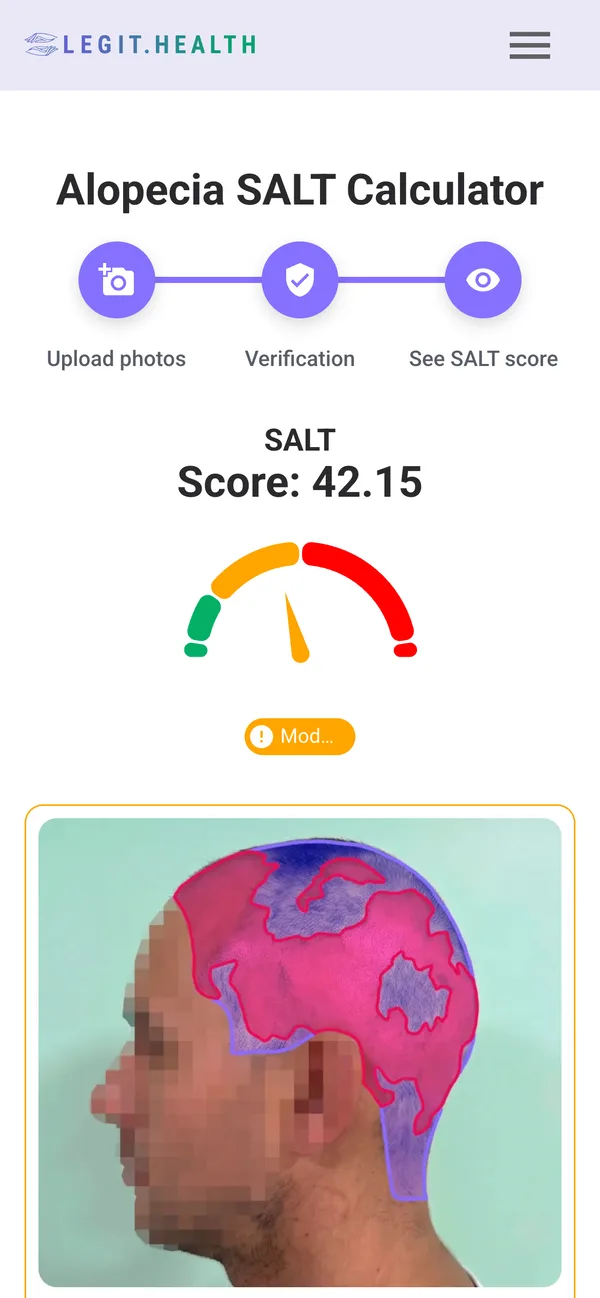
- Lilly, the SALT calculator (alopecia areata): turns four photographs of the scalp into an objective Severity of Alopecia Tool score during the consultation, so treatment decisions rest on a measurement rather than an estimate, and each patient's progress can be followed visit after visit. Built with Lilly in Hong Kong and Spain.
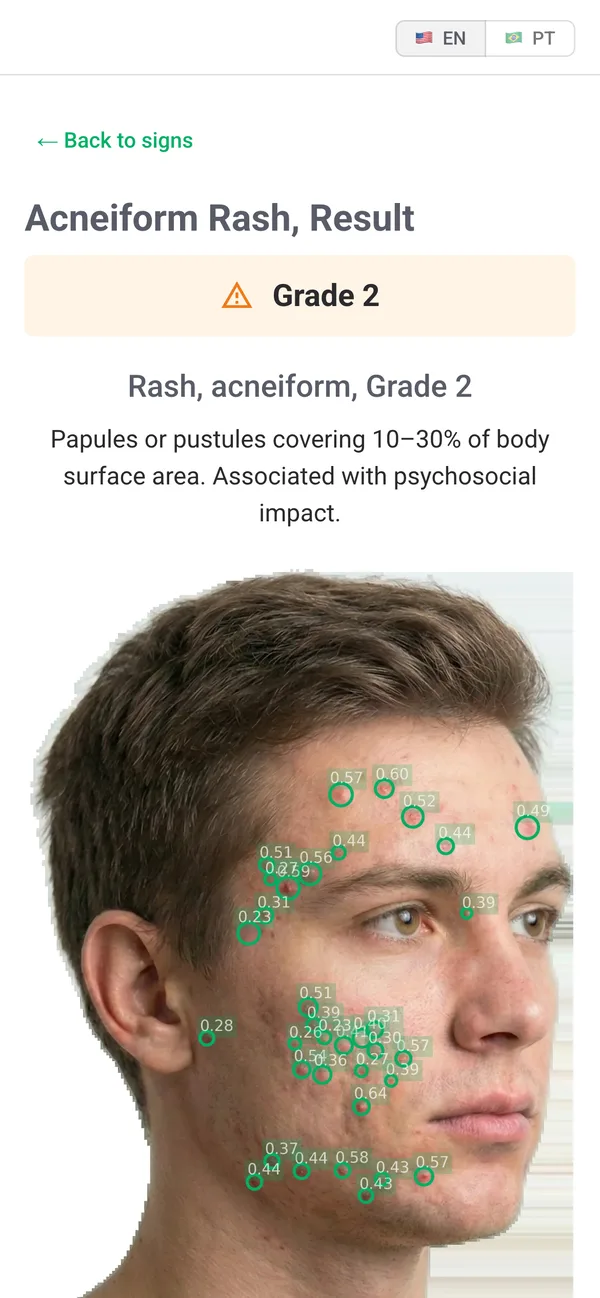
- Johnson & Johnson, Oncoderm (skin toxicity in oncology): helps oncologists grade five dermatological adverse events of targeted cancer therapies on the CTCAE v5.0 scale, from a photograph or a short questionnaire, so skin toxicity is recognised early and managed consistently, supporting patients through their cancer treatment. In use with oncologists and dermatologists in hospitals in Brazil.
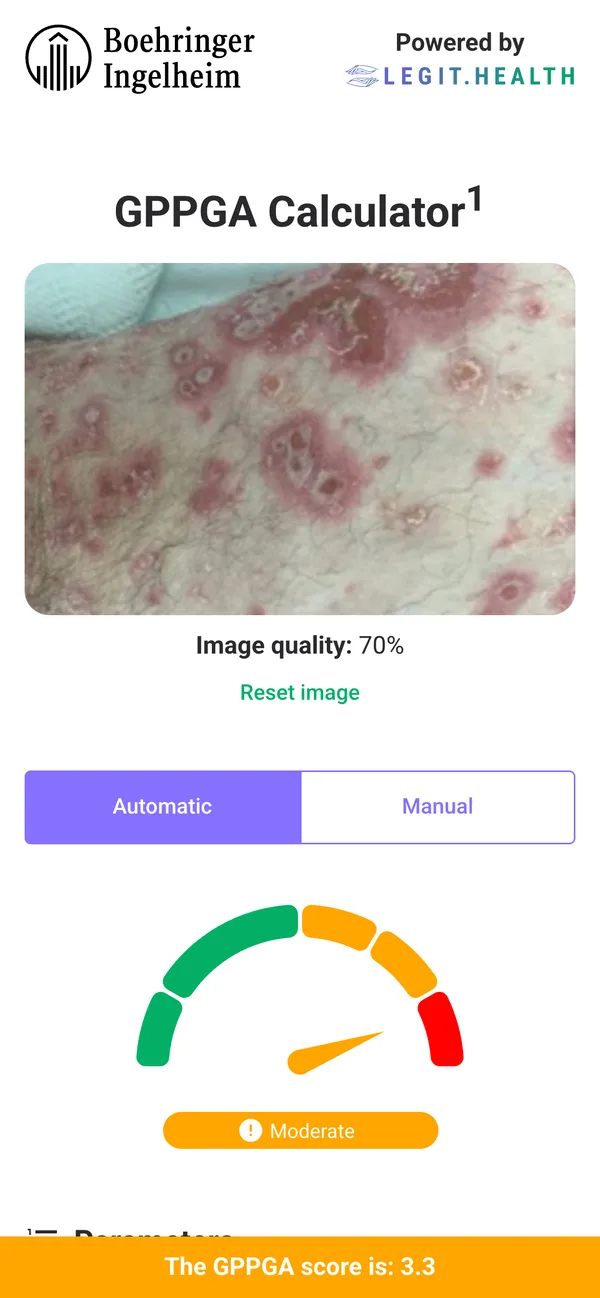
- Boehringer Ingelheim, the GPPGA calculator (generalized pustular psoriasis): brings the Generalized Pustular Psoriasis Physician Global Assessment to any clinician from a single photograph, scoring erythema, pustules and scaling, so a rare and potentially life-threatening disease is assessed with specialist consistency wherever the patient is first seen. Built with Boehringer Ingelheim in Spain.
Who is in the loop
Who does what.
Every role in a partnership is clear and deliberately narrow, so that clinicians and patients can trust the result. The partner brings its knowledge of the disease, Legit.Health brings the technology, and the clinician makes every decision.
- The pharma partner: brings its deep understanding of the disease and of the clinicians who treat it, supports the tool, and helps it reach the clinicians who can benefit from it. It takes no part in who uses the tool, and it never sees the patients' photographs or results.
- Legit.Health: designs, hosts and runs the tool, and assesses every photograph with the same medical device our other customers use.
- The clinician: uses the tool in the consultation, reviews every result, and keeps it in the patient's record.
- The patient: benefits from an assessment that is objective, consistent from one visit and one clinician to the next, and part of their record.
One partnership, step by step
From the disease to better decisions at the point of care.
A partnership, in five steps from the first conversation to the evidence that it makes a difference.
- The disease and the scale: The partner and Legit.Health agree the disease, the validated scale the tool scores, the countries and languages, and who may use it.
- The tool: Legit.Health builds it as a web page that opens on any phone, tablet or computer, or embeds it in the systems clinicians already use, so it fits into the consultation rather than adding to it. Every photograph is assessed by our medical device.
- The reach: The partner introduces the tool to the clinicians who treat the disease. Access never depends on the partner: the tool is open to the health professionals it is meant for.
- The consultation: The clinician takes the photograph, the quality check refuses one that cannot be scored, and the score comes back during the consultation. The clinician reviews it, shares it with the patient and keeps it in the record.
- The evidence: A partnership can measure how the tool is used and how clinicians value it. Oncoderm started in one hospital, measured its usability and the clinicians' satisfaction, and is extending to three hospitals.
What Legit.Health contributes
A new tool, the same measurement.
Each tool is new; the measurement behind it is not. Every photograph is assessed by the CE-marked medical device that public health systems, insurers and clinics already rely on, so a score means the same thing in every consultation and in every country.
How it works
- The image quality check, so a score is never given on a photograph that cannot support one.
- The severity score on the scale specialists already use: SALT for alopecia areata, the GPPGA for generalized pustular psoriasis, the CTCAE grade for acneiform rash.
- A ranked differential when a lesion fits none of the expected signs, as Oncoderm offers beside its five graded signs.
- A tool that opens in any browser with nothing to install, or that is embedded in a hospital's or the partner's own systems where that suits the workflow better.
Who works with us this way
Partners who share our commitment to better patient outcomes.
Lilly, Johnson & Johnson and Boehringer Ingelheim are three of the pharmaceutical companies we partner with, each in the therapeutic area it knows best.


Planifions unedémonstration en direct
Legit.Health est la solution d'intelligence artificielle tout-en-un avec des performances ultra élevées, des fonctionnalités exclusives et un soutien clinique.